• Digital Marketing vs. Affiliate Marketing: The 2026 Truth

    Digital Marketing vs. Affiliate Marketing: The 2026 Truth

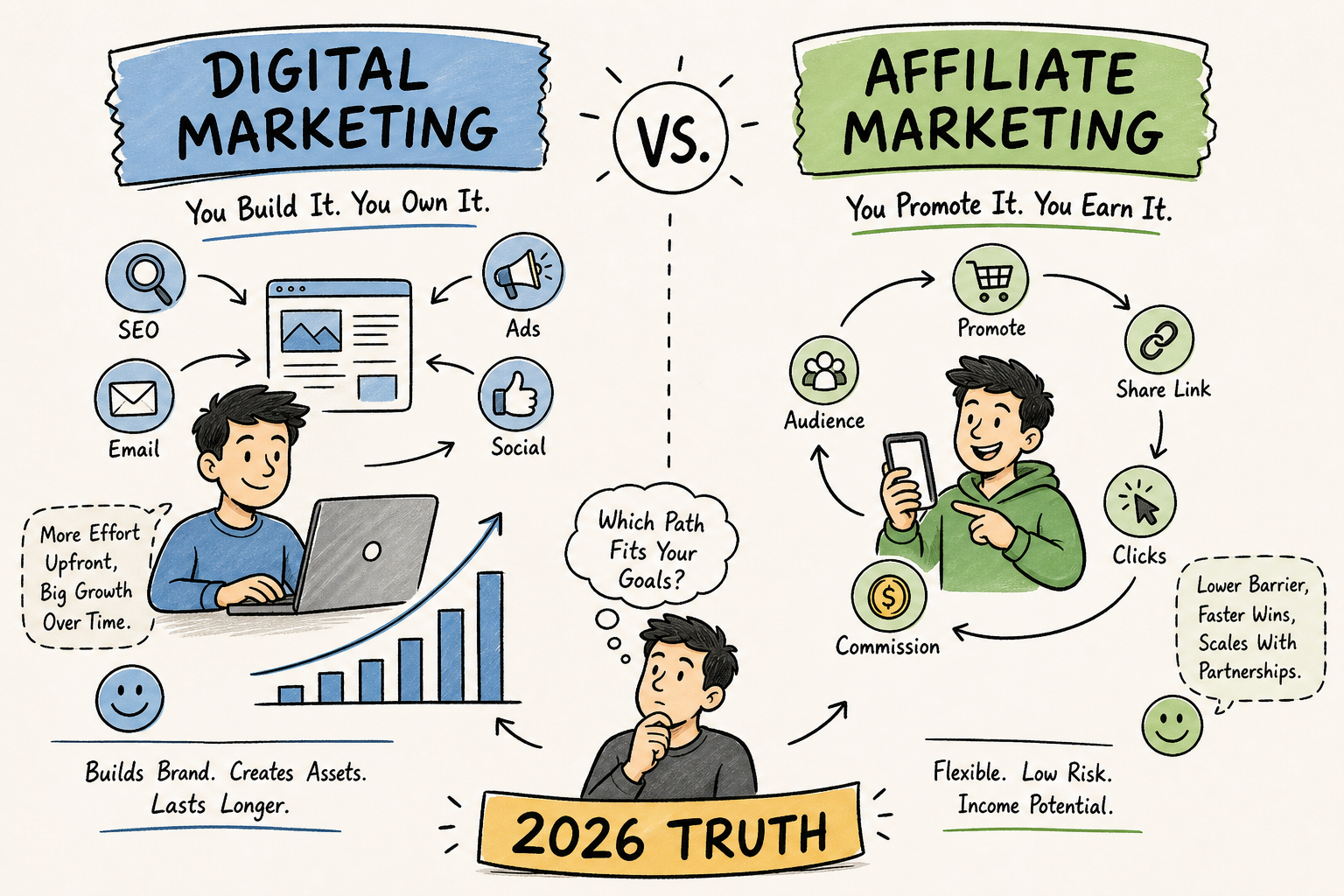
    Most people use “digital marketing” and “affiliate marketing” as if they mean the same thing. That confusion isn’t just semantic, it leads to wasted budgets, wrong strategies, and months spent on tactics that were never going to work for the goal at hand. The two concepts are related, but they aren’t interchangeable, and treating them as equals is one of the most common early mistakes we see at InternetMoneyPro.

    Here’s the short version: understanding digital marketing and affiliate marketing as distinct but connected disciplines is what separates people who get results from people who spin their wheels. Digital marketing is the full picture. Affiliate marketing is one specific model within it, defined by how payment works rather than where the promotion happens.

    By the end of this article, you’ll have a clear definition of both, a realistic look at costs and risk, a breakdown of which model fits which situation, and a straight read on how 2026 is reshaping the way both operate. No padding. Just what you actually need to decide which path to take.

    What digital marketing actually covers

    Digital marketing is the full set of tools businesses use to reach customers online. That includes search engine optimization, paid search, social media, email, display advertising, and video. These channels don’t operate in isolation. A Google Ad drives someone to a landing page; email follows up; retargeting ads bring them back. The entire pipeline is connected, and a business running direct digital campaigns controls every stage of it. For a practical primer on the fundamentals behind these channels, see this overview of digital marketing basics.

    That control has a cost. When you run in-house digital campaigns, you pay for every stage of the funnel whether it converts or not. SEO for a small business typically runs $1,500 to $5,000 per month. A modest Google Ads budget lands between $2,000 and $10,000 per month. Content marketing adds another $2,000 to $8,000 on top of that. And those are small-business figures. B2B software companies average $5,000 to $50,000 per month on Google Ads alone.

    The key characteristic of direct digital marketing isn’t the channel. It’s the payment structure. You spend upfront. You optimize afterward. The results are not guaranteed, and the financial risk sits entirely with you.

    Where digital marketing and affiliate marketing diverge

    Affiliate marketing lives inside digital marketing as a specific performance-based model that operates across multiple digital channels, distinguished by one thing: how money changes hands. Instead of paying upfront for clicks or impressions, a merchant pays affiliates only when a defined action occurs, typically a sale, a lead, or a broader acquisition event. If you want a clear, concise explanation of how affiliate marketing works at a conceptual level, this affiliate marketing guide is a solid reference.

    The structure involves four parties: the merchant who creates the product, the affiliate who promotes it, an optional network that connects them and handles tracking, and the customer who takes the action. The affiliate shares a unique tracking link through their blog, email list, YouTube channel, or paid ads. When a customer clicks and converts within the cookie window, the affiliate earns a commission.

    Commission models vary depending on what the merchant values. Pay-per-sale gives the affiliate a percentage of each transaction, typically 5% to 30%. Pay-per-lead pays a flat fee for every qualified signup or inquiry. CPA (cost-per-acquisition) covers any defined action. Recurring commissions, common in SaaS, pay the affiliate a percentage every month the customer stays subscribed. A SaaS tool that pays 30% recurring on a $100/month subscription creates compounding income for affiliates who build an audience once and collect commissions indefinitely.

    It’s also worth distinguishing affiliate marketing from referral marketing. Referral programs typically reward existing customers for bringing in new ones, usually with a one-time credit or discount. Affiliate marketing is a structured commercial arrangement with publishers, creators, or marketers who promote in exchange for performance-based commissions. The two models overlap in concept but differ in execution and scale.

    Costs, risks, and real ROI: digital marketing vs. affiliate marketing

    Upfront ad spend vs. CPA

    Direct digital campaigns carry the full financial risk. A PPC campaign can burn $5,000 in 30 days and return nothing if the targeting is off or the landing page doesn’t convert. There is no performance guarantee. Businesses with experienced teams and testing budgets can absorb that risk. Beginners and lean operators often can’t, and the data reflects how steep these costs get: legal services companies average $10,000 to $100,000 per month on Google Ads, and even e-commerce businesses at the small-to-mid level spend $2,000 to $25,000 monthly.

    Affiliate marketing fundamentally shifts that risk equation. The merchant pays only on confirmed results. Commission rates run 5% to 30% of sale value depending on the product and margin. Well-run affiliate programs deliver $6.50 to $15 for every dollar spent, with established programs reaching $16:1 in some cases.

    Merchant vs. affiliate risk

    For the affiliate, the risk is time and effort invested in content, promotion, and audience-building with no guaranteed return. For the merchant, the risk of a failed campaign disappears because payment is tied to results rather than activity. The trade-off is clear: merchants get lower financial exposure, while affiliates accept execution risk in exchange for scalable income potential. Neither model is categorically better. They serve different positions in the risk-reward spectrum, and understanding that difference is what lets you make the right call for your situation.

    Which business models actually win with each approach

    Affiliate marketing has a documented track record with high-margin, recurring-revenue products. SaaS tools, digital courses, and niche physical goods consistently perform well because the commission economics make sense for affiliates. Shopify pays up to $2,000 per referral. Semrush runs a hybrid model combining $200 per sale with $10 per trial. These programs work because the customer lifetime value is high enough to absorb a meaningful affiliate commission and still leave the merchant with a healthy margin. Wirecutter built an entire media business on this model.

    In 2026, AI tools and automation software have become the fastest-growing affiliate category. HubSpot’s affiliate program pays 30% recurring for up to a year. Education platforms like Coursera offer commissions up to 45%. The pattern is consistent: products with long subscriber retention and high ticket value create the best affiliate economics.

    In-house digital marketing outperforms affiliate channels in specific situations. Branded e-commerce, local services, and products requiring tight brand control are better served by direct campaigns. Private-label products need consistent messaging that a network of independent affiliates can’t reliably deliver. Businesses where customer data and retargeting pipelines are core assets should own their marketing channels. The rule of thumb is straightforward: if brand equity and the customer relationship are the primary asset, keep marketing in-house and invest in owning the funnel.

    How 2026 shifts are rewriting the affiliate playbook

    The affiliate environment in 2026 looks materially different from even two years ago. Cookie deprecation has forced programs to move toward server-to-server tracking, first-party data collection, and unique promo codes. The old reliance on third-party browser cookies is gone for most serious programs. Affiliates who haven’t updated their tracking setup are losing attribution they’ve earned. For practical options on moving beyond cookies, read about cookieless tracking solutions.

    AI tools are the other major shift. Affiliates using AI for content creation, audience segmentation, and conversion optimization are producing 30 to 50 pieces of content in the time it previously took to write one. AI-driven personalization generates 2 to 5 times higher click-through rates compared to static product lists. Predictive audience segmentation delivers 3 to 5 times higher conversion rates than traditional manual approaches. These are not marginal improvements. They’re structural advantages for affiliates who adopt these tools early. For a closer look at the evolving AI impact on affiliate marketing, that analysis is worth reviewing. If you’re ready to operationalize those benefits, our guide on how to use AI for affiliate marketing walks through a practical daily workflow.

    Commission structures are also evolving. Programs are moving toward tiered models that reward top performers with higher rates. Live commerce integrations on TikTok and Instagram now demand real-time tracking, while direct brand-to-affiliate partnerships are replacing impersonal network transactions. Brands are working more closely with affiliates as strategic partners rather than anonymous traffic sources. At InternetMoneyPro, our annual affiliate trend webinar breaks down exactly which niches are gaining traction, what commission models are rewarding affiliates most in the current environment, and where the next wave of performance-based opportunity is forming, practitioners use it to track which niches and commission models are actually paying out.

    A practical first-step checklist for choosing your path

    The choice between affiliate marketing and direct digital marketing isn’t a philosophical one. It comes down to four concrete questions. Answer them honestly and the right path becomes clear.

    • Do you have ad budget or time? Direct digital campaigns require upfront spend. Affiliate marketing requires content creation and promotion effort. If you have budget and a team, in-house campaigns are viable. If you have time but limited capital, affiliate marketing fits better.
    • Do you own a product or want to promote someone else’s? Merchants with their own offers should evaluate whether an affiliate program makes sense as a distribution channel. If you don’t have a product, affiliate marketing is the clear path, you promote what already exists and earn on results.
    • Do you need brand control? If consistent brand messaging is non-negotiable, run your own campaigns and maintain full oversight of every touchpoint. If you’re comfortable with performance-based promotion across independent publishers, affiliate marketing scales faster with far less operational overhead.
    • What’s your risk tolerance? Direct campaigns front-load the financial risk, you spend before you know if it works. Affiliate marketing shifts execution risk to the affiliate side. Choose based on what you can actually absorb right now, not what you hope to absorb later.

    For those who land on affiliate marketing as the right fit, the next question is how to execute without guesswork. That’s exactly what the system at InternetMoneyPro is built to answer, a step-by-step process focused on one offer, one clearly defined audience, and a repeatable structure that removes the random-tactics problem most beginners run into. If you want a structured starting point rather than reverse-engineering everything alone, that’s where to go next.

    The bottom line on digital marketing and affiliate marketing

    Digital marketing is the full picture. Affiliate marketing is one high-leverage channel within it, defined by its performance-based payment structure and its ability to scale without upfront ad spend. They’re not competing strategies, they’re different levels of the same map.

    In 2026, the two are converging. AI tools, server-side tracking, and first-party data strategies that once lived in enterprise marketing departments are now directly available to solo affiliate marketers. The gap between what a well-equipped affiliate can execute and what a funded in-house team can produce has narrowed significantly, a shift that’s opened real opportunities for independent operators who know how to use these tools.

    The right question isn’t which model is better in the abstract. It’s which fits your current resources, risk tolerance, and goals. When you understand digital marketing and affiliate marketing for what they actually are, distinct tools with distinct economics, the answer usually becomes obvious. If it points toward affiliate marketing and you want a proven path rather than a long trial-and-error process, InternetMoneyPro exists precisely for that.

  • Start Affiliate Marketing in 2026: Your First 8 Steps

    Start Affiliate Marketing in 2026: Your First 8 Steps

    Most people searching for how to start affiliate marketing already understand the concept. You promote someone else’s product, someone clicks your link and buys, you earn a commission. The model isn’t confusing. What stops beginners isn’t knowledge, it’s the volume of contradictory advice pulling them in six directions at once.

    The real problem is structural. People try Amazon links, a YouTube channel, a TikTok account, and a blog simultaneously, spread across three different niches, with no idea which effort is actually working. Nothing gets enough attention to gain traction, so most beginners abandon the whole thing within the first few months. That’s not a failure of ambition. It’s a failure of sequence.

    This guide walks you through 8 specific affiliate marketing steps in the right order: niche selection, program approval, channel setup, your first tracked link, and what realistic results actually look like. The InternetMoneyPro launch checklist serves as a practical companion as you work through each phase, helping you track daily progress without losing your place in the process.

    Why most beginners never make their first commission

    Affiliate marketing isn’t technically hard. Setting up a link can often be done in minutes. Writing a review article takes a few hours. The mechanics are accessible to anyone. The problem is that most beginners follow advice from multiple creators who each built their business differently, then try to run all those playbooks at once.

    Juggling Amazon links, a personal blog, a TikTok account, a YouTube channel, and three different product categories isn’t a strategy. It’s noise. None of it gets enough consistent attention to produce data, and without data, you can’t improve anything. You’re just busy.

    The simplest path to a first commission is a single offer promoted to a clearly defined audience through one channel. That constraint isn’t limiting, it’s how you actually learn what works. It’s how you generate enough consistent output to see patterns. The 8 affiliate marketing steps below are built around that principle.

    How to start affiliate marketing: picking a niche with real buying intent (Steps 1 and 2)

    Validating your niche before you commit

    Ignore the “follow your passion” advice. A viable niche needs products people already buy online, search demand with commercial intent, and affiliate programs that pay fair commissions. Passion helps you stay consistent, but it doesn’t validate a niche. Buyer behavior does.

    Here’s a quick validation method. Search “[your niche] best product reviews” in Google. If affiliate sites are ranking on page one and monetizing those posts, there’s money in that niche, someone is already earning commissions. Your job is to enter that space with better, more focused content. Strong starting categories include health supplements, digital marketing tools, personal finance apps, and home office gear.

    Anchoring your content around buyer-intent keywords

    Once you have a niche, anchor your content around buyer-intent keywords from day one. There’s a meaningful difference between someone searching “what is affiliate marketing” and someone searching “best email marketing tool for beginners.” The second person is closer to a purchase decision. That’s who you want to write for. Free tools like Google Keyword Planner and Ubersuggest can surface low-competition, high-intent phrases in your niche without costing anything.

    How to join affiliate programs as a beginner (Steps 3 and 4)

    Choosing your first one or two programs

    You don’t need ten affiliate programs. You need one or two that match your niche and have accessible approval requirements. The programs below consistently stand out for beginners because they don’t require existing traffic, an established website, or a large following to get approved.

    • Amazon Associates: Near-instant approval, commissions between 1% and 10% depending on category (a handful of specialty categories reach higher), 24-hour cookie window. Best for volume-based niches where purchase frequency is high.
    • ClickBank: Simple signup process, focused on digital products like courses and ebooks, commissions up to 75% on some offers, 60-day cookie. The gravity score inside the dashboard shows which offers are actively converting.
    • GetResponse: Recurring commissions between 40% and 60% per referred customer for the first 12 months, 90-day cookie, no website required. (Verify current rates at GetResponse’s PartnerStack page before applying.) Strong choice if your niche overlaps with email marketing or digital business tools.

    What to check before you apply

    Before applying to any program, review the commission rate and cookie duration, then confirm the minimum payout threshold and whether the product actually converts. For beginners, recurring commission programs are worth prioritizing because a single referred customer keeps generating income month after month. Amazon’s 24-hour cookie is a real limitation, but the product range and brand recognition make it worth including in volume-based niches.

    Once you’re comfortable with one or two programs, networks like ShareASale and CJ Affiliate open up access to thousands of additional merchants. Save those for after you’ve made your first commissions. Adding options too early is just another form of the scatter problem.

    Step 5: Setting up one promotional channel

    Fast-feedback channels vs. long-game channels

    Pick one channel and set it up properly before touching a second. The goal is a working setup within 7 to 14 days, not a perfect one. Here’s how the main options stack up for beginners in 2026:

    TikTok organic video tends to produce the fastest early conversions. The shoppable feed and impulse-buy behavior mean a single well-targeted video can drive clicks within hours of posting. YouTube Shorts compound well over time through both search and discovery; in observed campaigns, single product reviews have converted between 4% and 12% of viewers who click the description link, though results vary by niche and offer quality. For an overview of common best traffic sources for affiliate marketing, see industry roundups on where creators are finding early conversions.

    SEO through a niche blog is slower to start but pays off long-term once articles begin ranking. Email requires a list you don’t have yet. If you want fast feedback on whether your offer resonates, start with video. If you’re comfortable writing and willing to wait for traction, a blog is the more durable foundation.

    Minimum viable blog setup and FTC rules

    If you choose a blog, the minimum viable setup is: a domain, shared hosting under $10 per month, WordPress, and five initial articles targeting buyer-intent keywords. Every page needs an affiliate disclosure.

    FTC compliance note: The disclosure must be clear and conspicuous, placed before the first affiliate link in the content, not buried in a footer. Violations can carry civil penalties up to $51,744 per instance, so this isn’t optional. If you choose YouTube or TikTok, consistent branding and a content format you can produce weekly matter more than production quality at this stage.

    Launching and tracking your first offer (Steps 6 and 7)

    Generating your first tracked link is straightforward. Go to your affiliate program dashboard, find the product you’re promoting, generate a unique tracking link, and embed it in your content. Test that link before the content goes live, a broken link on a published page is a wasted click with no way to recover it.

    Place your FTC disclosure above or immediately near the link, not at the bottom of the page. Use UTM parameters or your affiliate dashboard’s built-in tracking to connect each content piece to its click data. Knowing which article or video is driving clicks tells you where to focus your next round of effort.

    This is where the InternetMoneyPro launch checklist earns its place. It covers the full sequence from program approval through your first published piece of tracked content, organized into a 30-day window with specific daily tasks across niche validation, technical setup, content creation, and promotion. Each task connects to the one before and after it, so you’re never guessing what to do next.

    Step 8: What realistic results look like at 30, 90, and 365 days

    Month one: clicks, not commissions

    Month one is mostly data collection. Expect clicks, not commissions. Most affiliate programs have payout delays of 30 to 60 days after a sale, and minimum payment thresholds that vary, roughly $10 on the low end to $100 for others. Your first commission check likely won’t arrive until month two or three even if a sale happens in week one. That’s normal. The number to watch in month one is click volume, not earnings.

    Month three: first commissions and SEO traction

    By month three, first commissions are realistic for beginners who have published consistently and maintained a single niche and offer. Blog posts in low-competition niches typically take 3 to 6 months to rank on page one of Google, which means SEO-driven income often starts showing up in this window for bloggers who launched in month one.

    Month twelve: scaling what already works

    By month twelve, a disciplined beginner following one niche, one offer, and one channel can reach $500 to $2,000 per month, some beginners report hitting this range in low-competition niches, though results vary and nothing is guaranteed. Scaling beyond that means adding content volume and optimizing what already converts, not jumping to new niches or programs.

    The four metrics worth tracking in the first 90 days are: click-through rate on your affiliate links, earnings per click, organic traffic growth, and conversion rate by content type. If clicks are strong but conversions are low after 60 days of consistent effort, the offer is likely the problem. If clicks are low, the content or channel reach needs work.

    The only thing left is to start affiliate marketing

    These 8 affiliate marketing steps come down to one core idea: one niche, one program, one channel, consistent action for 90 days. That’s not a shortcut, it’s a sequence that removes noise and keeps your effort pointed at what actually produces results.

    The InternetMoneyPro training system is built around this approach. It’s designed for beginners with no technical background and no existing audience, walking you through each phase with a diagnostic framework that shows what’s working and what needs fixing. If you want a clear system to track progress from day one through your first commissions, the InternetMoneyPro launch checklist is a practical place to start.

    You have the 8 steps. You have the sequence. Now go start affiliate marketing, pick your niche today and move to step two tomorrow.

    Frequently asked questions about starting affiliate marketing

    How long does it take to make your first affiliate commission?

    Most beginners who stay focused on one niche and one channel see their first commission between 60 and 90 days in. Payout delays of 30 to 60 days mean even a week-one sale may not pay out until month two or three. Month one is about generating clicks and learning which content works.

    Which affiliate networks are best for beginners?

    Amazon Associates, ClickBank, and GetResponse are the most beginner-friendly affiliate networks because they have straightforward approval processes and don’t require existing traffic. Broader networks like ShareASale and CJ Affiliate are worth exploring once you’ve made your first few commissions and have an active channel.

    Do I need a website to start affiliate marketing in 2026?

    No. Programs like GetResponse and ClickBank don’t require a website to apply. TikTok and YouTube let you add tracked links through video descriptions or link-in-bio tools. A blog becomes valuable for long-term SEO, but it isn’t a prerequisite for your first commission.

    What is the best niche to start affiliate marketing in 2026?

    The best niche is one with proven buyer intent, existing affiliate programs, and topics you can produce content around consistently. Health supplements, digital marketing tools, personal finance, and home office gear are all categories with strong affiliate ecosystems and consistent search demand.

    How do I know if my affiliate marketing strategy is working?

    Track four metrics in the first 90 days: click-through rate on your links, earnings per click, organic traffic growth, and conversion rate by content type. High clicks with low conversions usually point to a mismatched offer. Low clicks point to a reach or content problem. Both are fixable once you can see the data.

  • Affiliate Marketing Strategy: Why Yours Keeps Failing

    Affiliate Marketing Strategy: Why Yours Keeps Failing

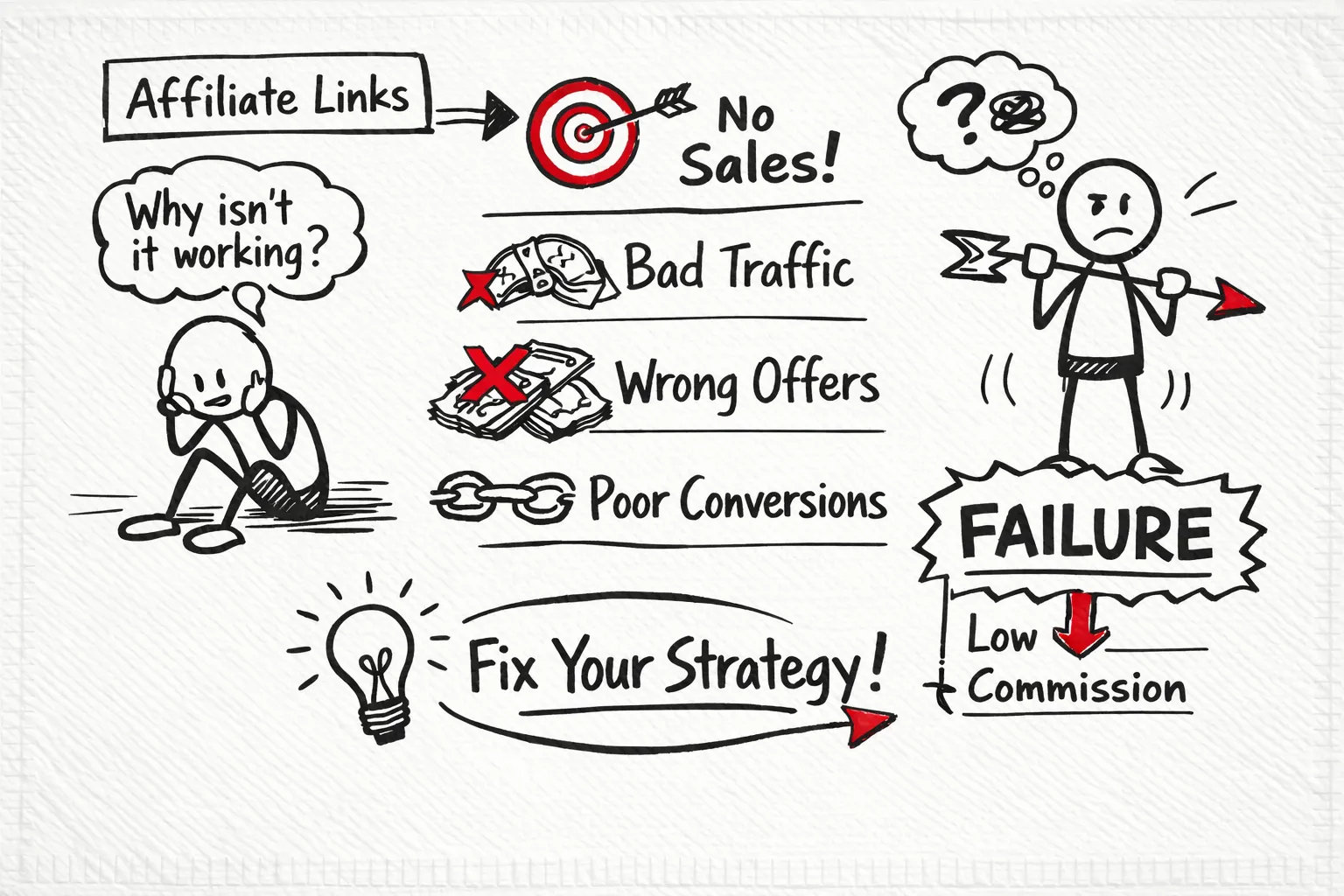
    Most affiliates running what they call an affiliate marketing strategy don’t actually have one. They have a collection of tactics picked up from YouTube videos, blog posts, and forum threads, stacked on top of each other with no real structure underneath. Many lack any documented plan at all, and the pattern shows up in the results: inconsistent commissions, weeks of work with nothing to show, and eventually quitting while convinced the whole model is broken.

    It’s not broken. The structure is missing.

    This article isn’t another tactics list. It’s a diagnostic. By the end, you’ll know exactly what’s broken in your current affiliate marketing strategy, how to audit it properly, and how to build a focused plan that actually produces results. The diagnostic framework here comes from the system built inside InternetMoneyPro, designed specifically to find the first broken link in an affiliate setup before adding more volume to a leaking bucket.

    The real reason affiliate marketing strategies fail

    There’s no shortage of affiliate marketing tactics, only structure

    Most affiliates consume advice endlessly. They read everything, bookmark everything, and test a little of everything. They add tactics the way people add apps to a phone: constantly, without ever removing what isn’t working. The result is chaos with a content calendar. Affiliate marketing tactics without a system are just experiments with no feedback loop. You don’t learn from them because you can’t isolate what changed.

    Promoting too many things to too many people

    Affiliates who focus on a single offer to a defined audience consistently outperform those juggling multiple programs across multiple niches. The Revo case study makes this concrete: a focused affiliate program strategy produced a +56% increase in revenue and a 65% improvement in average order value. Affiliates who scatter their attention across five programs and three niches rarely generate enough data from any single offer to know whether it’s working. They’re always guessing.

    The feedback loop that never gets built

    Without tracking and attribution configured before the first piece of content goes live, there’s no way to know what’s driving results. Most beginners run campaigns for weeks before realizing they have no measurable data. That’s not a traffic problem. That’s a structural problem, and adding more content on top of it just makes the confusion worse.

    Five warning signs your affiliate marketing strategy is broken

    Your conversion rate sits below 1% month after month

    Industry benchmarks generally show affiliate conversion rates running between 1-3% across most niches, with high-intent sectors like finance and SaaS reaching 4-8% (per 2026 affiliate benchmark reports). If you’re consistently below 1%, start by investigating upstream factors: audience match, content format, and offer fit, though product quality should be ruled out too. An EPC below $0.15 is another red flag tied to the same root issue. Strong programs push EPC to $1.50 or higher. If yours doesn’t, that gap needs explaining before you scale anything. Affiliate conversion optimization starts with diagnosing these numbers, not adding more traffic on top of them.

    You’re running multiple offers with no clear winner

    Scattered affiliate monetization strategies split your audience’s attention, and yours. When no single offer gets enough traffic to generate useful data, you’re always guessing. You can’t optimize what you can’t read. Focus isn’t a nice-to-have. It’s what makes the numbers readable and the decisions defensible.

    You can’t trace a commission back to a specific piece of content

    If you don’t know which post, email, or video drove a sale, you can’t replicate it. That’s the definition of a promotion plan with no feedback loop. Every content decision becomes a gut call, which compounds the problem month after month of effort going into a black box.

    How to audit your affiliate marketing strategy and find the gaps

    What a real affiliate strategy audit looks at

    A proper audit examines four components, and most self-audits skip three of them. The first is audience clarity: are you talking to one specific person with one specific problem? The second is offer alignment: does the product actually solve that problem convincingly? The third is content performance: which formats and topics are driving clicks and conversions? The fourth is tracking integrity: can you attribute results reliably back to individual content pieces? Most self-audits people run are just traffic reviews. That’s looking at the scoreboard without watching the game. Traffic is a symptom. These four components tell you the cause.

    Where InternetMoneyPro’s diagnostic framework changes things

    The system inside InternetMoneyPro was built to run exactly this kind of audit: starting with the audience, isolating the offer, and identifying the first broken link in the chain. It doesn’t assume the problem is more traffic. It asks whether the foundation is solid before adding volume on top of it. For affiliates stuck at zero commissions or inconsistent results, this is often the first time they’ve looked at their setup as a system rather than a series of individual moves. That shift is usually where the numbers stop being random.

    The gaps most self-audits miss

    Two components almost always get skipped. The first is commission model fit: is flat-rate or percentage commission better suited to your niche’s typical order value? The second is content-format mismatch. Industry data suggests email consistently outperforms most formats at roughly a 5.3% conversion rate compared to approximately 2.3% for product reviews, though your specific niche and audience behavior should guide which benchmark you apply. Picking the wrong format for the right audience is a slow leak that’s easy to miss until you audit it deliberately.

    Choosing the 3-5 partner marketing tactics that fit your niche

    Matching tactics to niche behavior and traffic type

    Finance and SaaS niches convert well through long-form comparison posts and email funnels. Visual niches like beauty and tech favor video content, studies on content format performance suggest video can deliver significant lift over text-only formats in these categories, though the exact range varies by niche and execution. The most common mistake is copying partner marketing tactics from a success story in a completely different niche and expecting the same results. Start with where your audience makes decisions. Then choose the format that meets them there. That sequencing matters more than which tactic sounds impressive.

    The 90-day constraint is your best filter

    If you can’t execute a tactic consistently for 90 days with your current resources, it doesn’t belong in your affiliate marketing strategy. Narrow the list to 3-5 moves you can actually maintain. The HealthyLife case study demonstrated what focus produces: by concentrating on high-performing lower-funnel partners, specifically cashback, loyalty, and coupon sites with dynamic reward structures, they achieved a 14%+ affiliate conversion rate and a +32% revenue lift during peak periods. Not because they did more. Because they focused hard on fewer things and executed those things well.

    Building your 90-day affiliate execution plan

    What each 30-day block should accomplish

    Days 1-30 are foundation work: one offer, one audience definition, tracking configured before a single piece of content goes live. Days 31-60 are about content execution with at least one email channel activated, this is when the data starts speaking, and you need to be ready to listen. Days 61-90 are for reviewing what’s converting, cutting what isn’t, and increasing distribution on what is.

    The Bombas case study illustrates this kind of disciplined sequencing: by moving away from coupon-heavy tactics toward full-funnel content affiliates, they grew affiliate revenue’s share of total revenue from 0.5% to 9%. That didn’t happen because they worked harder. It happened because they worked in the right order.

    The one rule that keeps the plan from collapsing

    Don’t add a new channel or tactic until you have a measurable result from the current one. Adding complexity before clarity is what turns a strategy back into a random pile of activities. One focused, tracked, iterated loop beats five simultaneous experiments every time. The plan only works if you protect it from your own impulse to do more.

    Tracking, attribution, and the KPIs that tell you the truth

    First-click vs. last-click vs. multi-touch: which one to use

    Last-click attribution is the default for most affiliate platforms and the least accurate picture of what’s actually driving conversions. It gives all the credit to the final touchpoint and ignores everything that built the decision before it. Multi-touch attribution, available through tools like Everflow and RedTrack, shows every touchpoint in the journey, and that matters especially in longer decision cycles like software or finance purchases. For beginners running simple setups, last-click is fine to start. But it should graduate to multi-touch as volume and complexity grow.

    The three KPIs worth tracking from day one

    Conversion rate is the first: target 1-3% to start and benchmark it against your specific niche. EPC is the second: below $0.15 is a red flag, while $1.50 and above indicates strong program-audience fit. Active content contribution is the third: which specific pieces are generating clicks and attributable sales. Everything else is vanity data unless these three are dialed in and reviewed weekly.

    Tools that are worth the cost

    Everflow fits larger operations at around $750/month with fingerprint and cookieless tracking built in. RedTrack suits media buyers scaling paid campaigns, with Conversion API support for Meta and AI-driven automation. For beginners, LeadDyno at around $49/month provides enough structure to start tracking meaningfully without the overhead. Note that pricing and features change, verify current plans directly with each provider. The tool matters less than the discipline of checking the data weekly and making one change at a time based on what it shows. Switching tools doesn’t fix a broken habit of ignoring the numbers.

    The fix starts with an honest look at what you already have

    Affiliate commissions don’t stay inconsistent because people lack tactics. They stay inconsistent because there’s no system connecting audience, offer, content, and tracking into one readable loop. A sound affiliate marketing strategy isn’t built from more activity, it’s built from knowing where the first thing broke and fixing that before anything else. When something breaks, you need to know where. That requires a diagnostic lens before anything else, not more content, not a new program.

    Before you publish another post or test another offer, audit what you already have. Run the framework outlined in this article. Or use the diagnostic system inside InternetMoneyPro to identify the first broken link in your setup and fix that one thing before building further. The system is structured specifically for this: starting with clarity, not volume.

    Consistent commissions aren’t the result of doing more. They’re the result of doing fewer things correctly, repeatedly. That’s how systems work.

  • Amazon Affiliate Program Sign Up: Step-by-Step Guide (2026)

    Amazon Affiliate Program Sign Up: Step-by-Step Guide (2026)

    The Amazon affiliate program sign up process is not an instant approval, and most beginners find that out the hard way. They fill out the form, get a conditional green light, and assume they’re done. They’re not. Amazon gives you exactly 180 days to prove your site drives real purchases. No sales within that window, and the account closes automatically.

    This guide is for anyone who wants to complete the Amazon Associates sign up correctly the first time, without getting rejected for avoidable reasons or losing the account during the conditional period. The same process is covered in detail inside InternetMoneyPro’s affiliate foundation training, but here you get the complete walkthrough in one place.

    By the end, you’ll know exactly what to prepare before you touch the application, what each screen asks for, and what a realistic path to your first commission actually looks like.

    What you need before the Amazon affiliate registration

    Age and tax ID requirements

    You must be 18 or older to apply. If you’re under 18, a parent or guardian can submit the application on your behalf. For US applicants, a valid SSN or EIN is required to complete the W-9 tax form during the application. International applicants fill out a W-8BEN instead. The tax details you enter must match your legal name exactly, because discrepancies delay payments and can trigger a compliance review.

    Payment method setup, direct deposit, check, or gift card, can be completed during the application or added afterward. Setting up direct deposit from the start is generally recommended: the minimum payout threshold is $10 for direct deposit compared to $100 for checks, and it speeds up your payments once commissions confirm. (Thresholds can vary by country; check Amazon Associates payout policy for your region.)

    The content foundation Amazon actually checks

    Amazon requires a qualifying platform before approving your application. A live website with original content, a YouTube channel, a mobile app, or a public social media page with genuine, active engagement all qualify. There is no officially published follower minimum for the standard Associates program, but an established public account, many practitioners suggest around 500 or more organic followers as a general benchmark, improves your approval odds considerably. The key word is “qualifying.” An empty blog or a brand-new site with two placeholder posts does not meet the standard.

    Amazon’s reviewers look for substantive, original content: buying guides, niche product articles, comparison posts, or category-specific material that demonstrates real editorial effort. At minimum, aim for 10 original posts published within the past 60 days before submitting. Build the content first, then submit the application.

    Amazon affiliate program sign up: screen by screen

    Account setup and payee information

    Go to affiliate-program.amazon.com and click “Join Now for Free.” You can log in with an existing Amazon account or create a new one. A separate account is cleaner for business record-keeping, though either option works. On the first screen, fill in your legal name, address, and a unique Associate ID. The Associate ID becomes your tracking tag, it appears in every affiliate link you generate, so choose something that reflects your niche or brand.

    Adding your website and describing your promotion method

    This screen is where most people get sloppy. Enter every qualifying URL, YouTube channel, mobile app, and social page you plan to use. Amazon cross-checks declared sources during review. Leaving out a traffic source that Amazon finds on their own raises flags, and that kind of inconsistency delays or kills an application.

    After listing your platforms, describe how you plan to drive traffic and promote products. Be specific: blog content, email marketing, social media, video reviews. Vague descriptions don’t help your application. A phone or email verification step may also appear at this stage depending on your account history.

    Completing your Amazon affiliate program sign up, tax and payment

    Complete the tax interview: W-9 for US residents (SSN or EIN required), W-8BEN for international applicants.

    Select your payment method and choose direct deposit. Then agree to the terms of service, complete the CAPTCHA, and submit. Conditional approval is granted immediately, you can start generating affiliate links right away without waiting for full review.

    Why Amazon rejects affiliate applications and how to prevent it

    The content and activity traps most beginners fall into

    Thin content is the single biggest rejection trigger. The review process flags sites that lack established, original material. Generic posts, keyword-stuffed filler with no real perspective, or articles that simply restate product specs without editorial value won’t pass. The site needs to look like something a real person built for a real audience.

    A few other failure points show up consistently:

    • Undeclared platforms: every site, social page, and app generating affiliate traffic must be listed. Unlisted platforms trigger rejections during review.
    • Missing the three-sale threshold: fewer than three qualifying purchases within the 180-day window results in automatic account closure. Personal purchases don’t count. Amazon tracks device, address, and payment method to identify self-referrals.
    • Links without a tracking tag: if your affiliate links don’t contain the Associate ID identifier (the unique tag ending in “-20”), sales won’t register as commissions even if customers complete purchases.

    FTC disclosures and Amazon compliance rules

    Every page containing affiliate links needs a clear disclosure statement. The Amazon-compliant language is: “As an Amazon Associate, I earn from qualifying purchases.” Per FTC guidance, that disclosure must be clear and conspicuous, positioned near the affiliate links, above the fold or immediately adjacent to them, so readers cannot reasonably miss it. Burying it in a footer or hiding it behind a “read more” break does not meet the standard. See the FTC influencer guidelines for more detail on disclosure expectations.

    One more compliance trap worth knowing: using product images downloaded directly from Amazon violates the terms of service. All product images must be generated through SiteStripe or the Product Advertising API, which pulls Amazon-hosted images in the approved format. Unauthorized image use is a commonly enforced policy that has resulted in penalties including warnings and account closures, it is not a gray area.

    From conditional approval to your first commission: the real timeline

    The 180-day conditional window

    The clock starts the moment you submit your application. Amazon grants conditional approval immediately, but full approval only follows after three qualifying sales have been made and your declared sites pass Amazon’s content review. That review happens after the sales, not before, which means your content and traffic strategy need to be working from day one.

    Those who publish content without any active promotion strategy often miss the window entirely, and the three-sale requirement closes out before they’ve figured out what to try next. The 180 days sounds like a generous runway. It isn’t, if you’re starting from zero traffic with no promotional plan. Some affiliates report hitting the three-sale threshold within 30 to 60 days when following a focused content system, though results vary depending on niche, platform, and how consistently they publish and promote.

    Creating your first affiliate links with SiteStripe

    Once you’re logged into amazon.com, the SiteStripe toolbar appears automatically at the top of every product page. Use the Text option to copy a short or full affiliate URL directly from any product listing. The Image option generates HTML code for embedding compliant product images. The Box option creates an embeddable product display for your site. For step-by-step help on link creation, review this guide on how to create affiliate links from Amazon.

    For mobile, the Amazon shopping app supports affiliate link creation under Share > Copy Associates Link. Some product types are excluded from mobile link generation, including eBooks, Audible titles, and digital magazines, so use desktop SiteStripe for those categories.

    Tracking pending earnings while they accumulate

    Commission reporting has a built-in delay. Earnings move from “pending” to “confirmed” after the customer’s return window closes, typically around 60 days after the purchase date (this can vary by product category and region). If you’re running multiple content pieces simultaneously, knowing which content is driving conversions matters early, not after two months of guessing.

    Inside InternetMoneyPro’s training dashboard, members cross-reference active content and promotional activity against pending commission data. That visibility is designed to help identify what’s working before earnings fully confirm, which is particularly useful during the critical 180-day window when every qualifying sale counts. For workflow ideas that automate parts of this process, see How to Use AI for Affiliate Marketing: A Real Daily Workflow.

    Building a real affiliate system beyond the application

    Why most new Amazon affiliates stall after sign-up

    Completing the Amazon affiliate program sign up takes five minutes. That’s not where the work is. The gap between conditional approval and consistent commissions comes down to whether you have a repeatable process for connecting a specific audience to a specific product. Most beginners don’t have one. They spread across dozens of product categories, target vague audiences, and produce content that generates impressions but not purchases, and the three-sale window closes while they’re still figuring out what to try next.

    The one-offer, focused-audience approach that actually converts

    InternetMoneyPro’s affiliate system is built around one principle: promote one offer to one clearly defined audience using a predictable, repeatable content process. That principle applies directly to Amazon Associates. Picking a single product category, understanding a specific buyer’s intent, and publishing content aligned with purchase decisions is what turns a conditional account into a fully approved one generating consistent commissions. If you need a structured restart, check out Starting Over With Affiliate Marketing: The Second Attempt Blueprint | InternetMoneyPro for a step-by-step recovery plan.

    The system also includes a diagnostic framework to identify what’s broken when commissions aren’t arriving. Whether the issue is audience targeting, content alignment, or link placement, the framework makes troubleshooting systematic rather than a guessing game. For beginners who want to clear the three-sale threshold in weeks rather than months, that structure is the difference between making it and missing the window. For additional perspective on broader affiliate tactics and program expectations, see Shopify’s guide to Amazon affiliate marketing.

    The short version, and what comes next

    Getting through the Amazon affiliate program sign up correctly means preparing your platform before applying, filling out every screen accurately, and having a plan to generate three qualifying sales within 180 days. The form itself is free and takes about five minutes. The work that determines whether the account survives starts immediately after submission.

    Build content before applying. List every platform you own. Use compliant links and visible disclosures. Set up direct deposit from day one. Then focus entirely on driving purchases from a defined audience, not just accumulating traffic that doesn’t convert.

    If the mechanics are clear but the system for generating consistent commissions isn’t, that’s what InternetMoneyPro covers, the strategy that makes the sign-up worth doing. The application is step one. Everything after it is where the real work happens. Learn more about our overall approach at Affiliate Marketing That Actually Works | InternetMoneyPro.

  • How to Build an Affiliate Marketing Website in 2026

    How to Build an Affiliate Marketing Website in 2026

    Most people make building an affiliate marketing website harder than it needs to be. They obsess over logos, spend weeks fiddling with colors, and never publish a single page. The reality is simpler: a focused site built around one niche, one audience, and one clear purpose will outperform a bloated, unfocused site every single time.

    This article gives you the practical blueprint for building an affiliate marketing website that earns, from picking a niche to writing your first review to getting ranked on Google. No filler, no theory. Just what actually works in 2026.

    Pick your niche before you touch a single setting

    Niche selection is the most important decision you’ll make when setting up an affiliate site. Every other step, your content strategy, program choices, and SEO, builds on top of it. A vague niche produces vague results. It’s that simple.

    Why narrow outperforms broad every time

    A focused niche builds topical authority faster, and Google rewards that. When your site covers one specific topic deeply, search engines classify you as an authority on that subject rather than a generalist with surface-level coverage. That distinction directly affects how quickly your pages rank.

    Consider the contrast: a “health and wellness” blog versus a site dedicated to fall detection devices for seniors. Both require similar effort to build. But the narrow site ranks faster, earns reader trust sooner, and converts at a higher rate because the audience arriving already knows exactly what they want. The broad site competes with thousands of established players. The narrow site competes with far fewer.

    The most profitable niches worth targeting in 2026

    Finance and loans consistently ranks at the top. Payouts per lead are high, consumer urgency is real, and you don’t need massive traffic to earn meaningful commissions. SaaS and business tools offer recurring commissions and high customer lifetime value. One referral can pay you for months. Senior care technology is a standout low-competition opportunity: high emotional investment from buyers, a growing demographic, and very few affiliates targeting it seriously.

    Health and wellness remains evergreen with reliable year-round demand, and AI tools have emerged as a fast-growing sub-niche with 20, 40% recurring commissions on many programs. The question worth asking yourself: which of these aligns with what you already know, follow, or care about? That alignment matters more than chasing the highest commission rate, because it affects how consistently you can produce content over the first 90 days when results are still building. For a broader perspective on current niche opportunities, see this list of best niches for affiliate marketing.

    Build an affiliate website without overthinking the tech

    The technical setup is not where your attention belongs. Make one good decision here, execute it, and move on. The sites that earn run on simple, proven setups that stay out of the way, not exotic tech stacks.

    WordPress and managed hosting: the clear choice for affiliate sites

    WordPress paired with managed hosting from providers like SiteGround or Kinsta gives you the best cost-to-performance-to-security tradeoff for an affiliate site in 2026. You get server-level caching, CDN delivery, daily backups, WAF protection, and Core Web Vitals compliance built into the infrastructure. Budget around $25, 50 per month, the right investment for a site built to earn. Site builders like Wix and Squarespace work fine for portfolios but fall short on affiliate SEO flexibility and customization depth.

    Managed hosting providers handle the server side automatically, and WordPress installations take minutes. Most beginners with basic computer literacy can get a site live with no prior web development experience. The goal is to be writing and publishing within your first week, not debugging server configurations. If you want a quick primer on picking the right managed option for WordPress, this best managed WordPress hosting guide is a useful place to start.

    The pages your affiliate site needs from day one

    Before you write a single review, make sure these five pages exist on your site:

    • Homepage: A clear niche statement, not a generic welcome message. Visitors should know immediately what this site is about.
    • About page: Who you are and why you cover this niche. This builds trust with readers and credibility with brands.
    • Review and comparison pages: Your money pages, this is where you earn commissions.
    • Disclosure page: FTC compliance is non-negotiable. Every affiliate site needs one before publishing affiliate links. (See the FTC’s endorsement guidelines for required language.)
    • Contact page: Builds credibility with both readers and affiliate program managers reviewing your application.

    If you’re starting from scratch, the The Blog | Real Answers for Real Affiliate Marketers | InternetMoneyPro gives beginners a pre-structured starting point organized around this exact page setup. You spend your energy on content instead of layout debates.

    Write content that actually sends people to buy

    Not all content converts. A post that attracts curious readers is different from a post that attracts buyers. Knowing which formats drive affiliate clicks is the difference between a hobby blog and a site that earns predictably.

    Reviews and comparisons outperform everything else

    Product reviews consistently show among the highest conversion rates of any affiliate content type, because they attract readers with clear commercial intent. Someone searching “best project management software for freelancers” is already in buying mode. Comparison pages, pitting Product A against Product B, capture decision-stage readers who are one step from purchasing. Tutorials and how-to guides work well when they show the product in action and pair the demonstration with an honest recommendation. For data on how review and comparison content converts across channels, see these affiliate conversion statistics.

    Listicles drive discovery traffic and can work for awareness, but they rarely convert as consistently as a dedicated review page. Build your content calendar around reviews and comparisons first, then add supporting content like tutorials and guides once those foundational money pages are live.

    How to structure a high-converting review page

    Lead with a clear verdict. Don’t bury your conclusion at the bottom of a 3,000-word page. Readers who find a review already want guidance, so give it to them immediately and let the rest of the page justify that recommendation. Include an honest pros and cons section, readers trust balanced assessments far more than pure promotional copy.

    Place affiliate links contextually within the content, not just as a button at the very end. Use a comparison table when reviewing multiple products side by side. Add an FAQ section at the bottom to capture long-tail search queries and extend time-on-page. Target 2,000 or more words of original, experience-based content. Thin reviews don’t rank, and they don’t convert.

    Join affiliate programs that work for new publishers

    The right affiliate network matters as much as the commission rate. A high payout attached to a slow or restrictive approval process keeps a new site stuck. Start with programs that let you earn while your traffic is still growing.

    Networks that are actually beginner-friendly

    ClickBank offers free sign-up with no approval wait and commissions of 50, 75% or higher on digital products. Impact has no minimum payout threshold, a 45-day cookie window, and access to over 2,500 partner brands. CJ Affiliate’s Content Certification program gives new publishers pre-approved access to over 600 brands, bypassing the slow individual application process that trips up most beginners. Skimlinks automatically converts existing links to affiliate links with no manual setup, a practical choice for content-heavy sites in early stages.

    What to evaluate beyond the commission rate

    Cookie length is more important than most beginners realize. Amazon’s 24-hour cookie means you lose credit if a buyer takes two days to decide. A 30 to 45-day window is far more publisher-friendly and can meaningfully boost your earnings with zero extra effort. Payment frequency also matters early on: weekly or bi-weekly payouts beat NET-60 terms when you’re building momentum and need to see proof the system is working.

    Recurring commissions from SaaS programs are worth targeting from the start. One referral that pays monthly for as long as the customer stays builds compounding income rather than one-off payouts. Acceptance criteria vary widely, so start with open-access networks and expand to brand-specific programs once your site has some content and traffic to show in your application.

    Affiliate website SEO: the on-page fundamentals that move the needle

    You don’t need to be an SEO expert to get results. You need to get the fundamentals right on every page you publish, then do it consistently. That alone puts you ahead of most affiliate sites, which get the basics wrong or skip them entirely.

    The on-page elements that matter most

    Your title tag should place the primary keyword near the front, stay under 60 characters, and read like something a human would actually want to click, for example: “Best [Product] Review 2026: Compared and Ranked.” The H1 should match search intent exactly and use the same keyword as the title. Keep your URL short and keyword-rich with no filler words. Your meta description should stay under 155 characters, include the keyword, and be written like a small ad that earns the click. Every image needs descriptive alt text with relevant keywords, and every image should be compressed to protect page speed, tools like ShortPixel or Squoosh make this straightforward, and Google’s Core Web Vitals documentation explains why load performance directly affects rankings.

    Schema markup and internal linking for affiliate pages

    Add Product Schema for each item you review, covering name, price, rating, and availability. Use Review Schema for aggregate ratings and pros and cons, which creates trust signals directly in search results. FAQ Schema captures question-based queries without requiring separate pages for each one. These structured data additions don’t guarantee rankings, but they improve how your pages appear in results and drive higher click-through rates.

    For internal linking, use a hub-and-spoke structure. A pillar category page links to individual reviews using keyword-rich anchor text, and each review links out to three to five related pieces. This distributes link equity across your site, signals topical authority to Google, and keeps readers moving through your content. Target a page load time under 2.5 seconds. Managed hosting handles most of this automatically through server-level caching and CDN delivery.

    What the first 90 days of building an affiliate marketing website actually look like

    Most people quit before the site has had enough time to work. They expect traffic and commissions in week three, and when those don’t materialize, they assume something is broken. Set the right expectations now, and you’ll stay consistent long enough to see real results. If you’ve tried and failed before, this Starting Over With Affiliate Marketing: The Second Attempt Blueprint | InternetMoneyPro walks through the exact mindset and actions for a successful second attempt.

    A realistic timeline from launch to first commission

    In weeks one and two, your focus is getting the site live with essential pages published and your first two pieces of content drafted. Weeks three through six are about building a consistent publishing rhythm: one to two review or comparison posts per week, with affiliate links in place on every page. By weeks seven through twelve, Google begins indexing and testing your pages, and organic traffic starts trickling in.

    First commissions in the 60 to 90-day window are achievable, particularly when you target low-competition, long-tail keywords from day one. That said, most sites see consistent earnings closer to the 3 to 6-month mark, and full ranking authority typically stabilizes between 6 and 12 months, if you want a deeper take on how long SEO takes to produce results, see this guide on how long SEO takes to work. The InternetMoneyPro system is structured around that early-wins window because following the process without skipping steps gives beginners the best shot at seeing results before motivation fades. The key is not quitting before the timeline has had a chance to play out.

    What to track and adjust in the early months

    Google Search Console shows you which queries your pages are appearing for, even when you’re not yet ranking high. Watch impressions, clicks, and click-through rate (CTR), these tell you whether your content is being indexed and whether your titles are earning clicks. Track click-through rates on your affiliate links: if people read your reviews but don’t click, your call-to-action placement or link positioning needs work. Monitor bounce rate on review pages. A high bounce rate often signals that the content doesn’t match what the reader expected from the headline.

    Don’t overhaul everything at once. Make one change at a time and give it three to four weeks before drawing conclusions, SEO changes in particular need time to register in rankings and organic traffic. Systematic adjustments compound over time. Reactive overhauls just create noise and make it impossible to understand what’s actually driving results.

    The bottom line

    Building an affiliate marketing website is a decision problem first, and a technical problem second. Pick the right niche, build a clean site on proven infrastructure, write content that matches what buyers are actually searching for, and choose programs that pay fairly and accept new publishers. The sites that earn are not the most elaborate ones. They’re the most focused.

    Consistency over the first 90 days is what separates affiliates who earn from affiliates who quit. Do the simple things well, one niche, one audience, one system, executed repeatedly. The results follow from that, not from finding a better plugin or a more elaborate site design.

    If you want a system that removes the guesswork from every step described in this article, the What an Affiliate Marketing System That Works Actually Looks Like | InternetMoneyPro training program walks you through the entire process from niche selection to your first commission, with templates, diagnostics, and AI-enhanced tools built in. Focused, practical, and built for beginners who want results, not busywork.

  • Profitable affiliate niches in 2026: how to pick yours

    Profitable affiliate niches in 2026: how to pick yours

    Picking an affiliate niche feels like the easy part. It’s where most people quietly set themselves up to fail. Someone watches a video about high-paying affiliate programs, picks personal finance because “the commissions are huge,” and spends three months building content that competes directly against sites with ten years of domain authority. Nothing converts. They blame affiliate marketing.

    The problem wasn’t the niche. It was the selection process. Profitable affiliate niches aren’t chosen by gut feel or trend-chasing. They’re validated against demand, fit, and program quality before you write a single piece of content. This article covers which niches actually earn, where the low-competition pockets are, and how to confirm your pick before you write a word. At InternetMoneyPro, niche selection is the first diagnostic step in the entire affiliate system, because everything downstream, from your content to your conversions, depends on getting this right.

    Why most people approach niche selection backwards

    Most beginner affiliates start with “what’s popular” and work backwards to find an audience. That’s the wrong order. Profitability follows fit, not fame. A niche that’s hot without an audience you understand or content you can produce at volume is just noise dressed up as opportunity. If you’re stuck and want a practical fix for common mistakes, read Why Affiliate Marketing Isn’t Working for You (And the Real Fix) | InternetMoneyPro.

    The gut-feel trap

    The pattern repeats constantly. Someone picks personal finance because commissions are high, builds three articles, realizes they have nothing original to say, and quits. The flip side is equally useless: genuine passion for a niche with no audience demand means months of work with no one to read it. Both scenarios waste time you won’t get back.

    The two variables that actually matter

    Before you look at commission rates or competition scores, confirm two things: demand (people actively searching and spending money in this space) and fit (you can produce content here consistently without burning out). Everything else is secondary validation, including commission rates, which matter a lot but only after demand and fit are confirmed. This is exactly why we document What an Affiliate Marketing System That Works Actually Looks Like | InternetMoneyPro, it forces you to validate before you commit.

    Affiliate niches with the strongest earning potential right now

    The useful question isn’t which niches exist, it’s why certain categories outperform others. The best niches for affiliates in 2026 share two core traits: recurring revenue potential and high customer lifetime value, paired with audiences that research before they buy.

    Recurring commission niches: SaaS and AI tools

    SaaS and software subscriptions are the most structurally sound category for affiliate income. Standard commission rates run 20, 50% recurring monthly or annually. Systeme.io pays 60% recurring. Webflow pays 50% of first-year revenue. HubSpot offers 30% recurring for the first 12 months or a flat $1,000 per sale. The reason these numbers hold up is simple: once someone integrates a tool into their daily workflow, they rarely cancel. A single referred customer can generate affiliate income for years. High-paying affiliate niches in SaaS reward patience and a focused content strategy over raw traffic volume. For an outside perspective on the most lucrative categories, see this guide to the highest-paying affiliate niches.

    High-ticket and fintech niches

    Fintech and investment platforms pay flat fees of $50, $200 per funded account. eToro pays up to $200 per account. Empower pays up to $100 per qualified lead. One conversion here can outperform dozens of small product commissions from physical goods. Health, wellness, and digital education also belong in this tier, with 30, 70% commissions on course sales and strong demand trends through 2026.

    Sleep aids, hair health products, and sauna gear are all showing 31, 65% year-over-year search growth (per Exploding Topics data). These reflect a structural shift in consumer spending, not a cycle, driven by sustained audience investment in personal wellness rather than seasonal spikes.

    Platform fit by niche type

    The niche you pick should match the platform where your audience gathers. SaaS converts best through blogs, email sequences, and YouTube tutorials where buyers research before committing. Wellness and beauty convert through Pinterest and short-form video, where visual content drives discovery and impulse-adjacent decisions. Fintech leans heavily on long-form SEO content because buyers want detailed comparisons before handing over financial information. Knowing this before you start saves you from building the wrong content format for your niche.

    Low-competition affiliate niches worth entering in 2026

    The main categories, finance, health, and SaaS, are competitive at the top level. Competing head-to-head with established authority sites on broad terms is a losing strategy for a new site. The opportunity sits one layer deeper, in the sub-niche layer where long-tail demand exists but fewer sites are specifically targeting it. These low-competition affiliate niches are where new publishers can gain real traction within months rather than years. See practical examples of low-competition blog niches to understand how narrow angles can win faster.

    What a good affiliate sub-niche looks like

    A worthwhile affiliate sub-niche has multi-word search terms with buyer intent, fewer than 20 strong competitors in the top 10 SERP results, and at least two affiliate programs that pay commissions worth the content investment. The goal isn’t zero competition. Zero competition usually means zero demand. You’re looking for manageable competition with a clear content angle that existing sites haven’t addressed well.

    Subniches with measurable demand right now

    Several niche ideas for affiliate marketing show strong long-tail signals with lower keyword difficulty than their parent categories. AI apps for anxiety and mood tracking sit at the crossover of mental health and AI tools, two independently growing markets, with search terms like “AI apps for anxiety tracking daily” generating real volume and minimal established competition. Apartment-friendly home gym setups (foldable equipment, quiet treadmills for noise-sensitive buildings) target a specific buyer with a specific problem that generic fitness content doesn’t solve.

    Postpartum recovery products, beginner kombucha fermentation, and ethical AI compliance tools for small businesses each follow the same pattern: specific audience, specific problem, underserved search demand. New sites can rank for these within months rather than years because the competition is genuinely thinner.

    How to match a niche to your actual skills

    A niche with strong commission potential means nothing if you can’t produce content in it consistently for six to twelve months. This part requires honesty, not optimism.

    Content format and skill alignment

    Be direct with yourself about your actual format strengths. Are you a writer, a video creator, or a short-form content person? Health and beauty convert well on Pinterest and TikTok, which favor visual creators. SaaS converts through detailed written tutorials and YouTube comparisons, which favor writers and educators. Your content format should match your skills, and your skills should match the niche’s primary platform. Misaligning these is a common and avoidable mistake.

    Audience clarity before content creation

    Niche selection for affiliates only works when you can describe your reader in one clear sentence. “Wellness” is a topic category. “New moms recovering from diastasis recti looking for low-impact workouts” is an audience with a specific problem and buying intent. The narrower your audience definition, the more useful your content becomes, and the more trust you build before asking someone to click an affiliate link. Write that one sentence before you commit to any niche.

    A simple checklist to validate your niche before you commit

    Once you have a niche candidate, run it through three concrete steps. Each one has a clear action and a clear pass or fail signal. Skip any of these and you’re building on assumptions.

    Step 1: Keyword demand check

    Use Google Keyword Planner, SpyFu, or SE Ranking to confirm that high-intent keywords in your niche, specifically those with “best,” “review,” or “vs.” modifiers, have measurable monthly search volume. If the top keywords show fewer than 500 monthly searches and no commercial CPC, the demand isn’t there yet. A niche without search volume is a niche without buyers, regardless of how good the affiliate programs look on paper. For deeper reads on spotting high-intent keywords and how to weigh keyword volume vs difficulty vs search intent, review those guides when you do your research.

    Step 2: Affiliate program audit

    Confirm at least two to three affiliate programs exist in the niche with commissions worth building around. The benchmarks for high-paying affiliate niches are recurring commissions above 20% or flat fees above $50 per conversion. If the best program in your niche pays 4% on a $30 product, the math doesn’t support a serious content investment. This check takes thirty minutes and can save you months of misdirected effort.

    Step 3: Content angle gap analysis

    Search the top 10 results for your main target keyword and identify what’s missing: depth, a specific audience angle, updated information, or a format the existing content doesn’t use. If you can answer the question better, or for a narrower audience than the current top-ranking pages, you have a content gap worth targeting. Systematizing this step through a dedicated tool or a saved research template is what separates affiliates who move fast from those who stall on the starting line.

    Choose your affiliate niche and validate it

    The right affiliate niche isn’t the most famous one or the highest-paying one in the abstract. It’s the one where measurable demand exists, your content has a clear and defensible angle, and the affiliate programs pay commissions that justify the work. You don’t need to cover twelve niches or hedge your bets across three topics. Pick one, validate it properly, and build.

    The checklist above is the bridge from research to action. Take the niche you’re currently leaning toward, run it through all three steps this week, and either confirm it or cut it. If it passes, you have a clear starting point. If it fails, you’ve saved yourself months of wasted content. Indecision is the only guaranteed path to earning nothing from an affiliate niche. For ongoing guidance and frameworks, visit Affiliate Marketing That Actually Works | InternetMoneyPro.

  • Affiliate Marketing Content Formats That Actually Convert

    Affiliate Marketing Content Formats That Actually Convert

    Affiliate marketing content fails most often not because of low traffic, but because the format is wrong for the reader who shows up. A first-time visitor who just heard about a product needs something different from someone who has already compared three options and is ready to buy. Serving both readers the same content format is a core problem, and many affiliates never address it.

    The obsession with traffic numbers is a distraction. Page views feel like progress, but if your affiliate marketing content format doesn’t match where the reader sits in their buying journey, those visits rarely convert. The affiliates who build consistent income solve the format problem first, then scale. InternetMoneyPro is built around this principle: a focused training system designed to match content format to audience intent from day one.

    This article covers the five things that determine whether your affiliate content earns: the formats that actually convert, SEO structure, AI tools, FTC disclosures, and how to build a workflow you can repeat.

    Why most affiliate marketing content fails before it even converts

    The format-audience mismatch nobody talks about

    Most affiliates write the content they feel comfortable creating, not the content their audience needs at that specific stage of the buying journey. A tutorial works for cold traffic that’s still exploring. A comparison post works for someone who already knows what category of product they want and is narrowing down options. Writing the wrong affiliate content type for the wrong stage is why most affiliate posts earn nothing, regardless of word count or how many links they contain. (Why Affiliate Marketing Isn’t Working for You (And the Real Fix) | InternetMoneyPro)

    Here’s a concrete example. A 3,000-word post explaining “what is email marketing” with affiliate links to an email tool will rarely convert. The reader is in research mode, not buying mode. They’re not ready to act on a recommendation. The content answered their question but was never designed to move them toward a purchase decision.

    Chasing page views instead of purchase intent

    High page views with zero revenue is a diagnostic signal: the content is attracting browsers, not buyers. Transactional and commercial investigation keywords, phrases like “best email tool for e-commerce” or “Mailchimp vs ConvertKit for small business”, pull in readers who are already close to a decision. That’s the traffic that converts. Broad informational traffic isn’t worthless, but it requires a different affiliate content strategy to eventually monetize.

    Industry benchmarks suggest written product reviews average around a 2.3% conversion rate, video reviews can reach roughly 5.8%, and combined written-plus-video formats may hit 7.2%, though rates vary by niche, product, and measurement method. Those numbers only hold when the format and the reader’s intent are aligned. More content at the wrong stage of the funnel doesn’t fix a format mismatch. It just creates more of the same problem at scale. For current industry data and broader conversion benchmarks, see affiliate conversion statistics.

    Affiliate content formats with the highest conversion rates

    Affiliate product reviews and comparison posts

    Honest product reviews that include real pros and cons are the most trusted format in affiliate marketing content. They convert at roughly 2.3% on average for written posts and can jump significantly when paired with video. The key is specificity: vague praise doesn’t build trust, but a clear breakdown of who the product is right for, and who should skip it, does. Readers recognize a manufactured endorsement quickly, and it kills conversions.

    Comparison posts work best for readers in the final decision stage. They’ve narrowed their options and need someone to cut through the noise and give them a clear answer. Use a defined winner, explain the tradeoff honestly, and make the affiliate link the logical next step rather than an interruption. For example, a clear winner section that states “For most small business owners, Tool A is the better choice because of X” gives the reader exactly what they came for. That’s how a comparison post earns. For a practical guide to which formats perform best, check this article on the best content formats for affiliate marketing.

    Tutorials, roundups, and deal alerts

    How-to tutorials work well for products that need demonstration: software, tools, physical gear with a learning curve. The goal is to show the product solving a real problem, not just list its features. When readers see a product working in context, the buying decision becomes easier. That’s a format advantage you can’t replicate with a description alone.

    Roundups targeting commercial intent searches, “best tools for building an email list under $50,” for instance, give readers multiple paths to a decision and multiple affiliate links in one post. Deal alert content, whether published as a blog post or sent as an email, creates genuine urgency when there’s an actual promotion involved. These affiliate content types outperform generic informational posts because they mirror how buyers actually search when they’re ready to spend money.

    Email newsletters and social proof content

    Email is the most direct channel for affiliate conversions because you’re reaching people who already opted in and trust your recommendations. A newsletter built around a specific product promotion or curated recommendation consistently outperforms cold traffic content because the relationship is already established. Affiliate links in email carry more weight than the same links in a post a stranger found through search.

    On social platforms, tutorials, before-and-after posts, and Q&A content drive affiliate clicks by showing a product working in someone’s real life. The common thread across every high-converting affiliate content idea is the same: one product, one specific outcome, one clear next step. Dilution kills conversions. Focus earns them.

    SEO and headline structure that gets your affiliate marketing content found and clicked

    Targeting buyer-intent keywords over broad topics

    The keyword type matters more than keyword volume. Transactional phrases like “buy [product] discount,” “[product] coupon code,” or “best [product] for [specific use case]” attract people who are ready to act. Long-tail variations like “best wireless headphones under $100” carry lower search volume but far higher conversion precision. Broad informational terms attract curious readers, not buyers, and they rarely justify the SEO investment for affiliate content.

    For a practical affiliate content strategy, commercial investigation and transactional keywords should make up the bulk of your target list. The research is straightforward: if someone is typing “[Product A] vs [Product B],” they are one good comparison post away from clicking your link. Build your affiliate marketing guide around those searches first.

    Title tags, headings, and schema that improve rankings and clicks

    Place the primary keyword early in your H1 title and keep it under 60 characters. Use H2 and H3 subheadings with natural keyword variations rather than forced repetition. A heading like “Best Options Under $50” signals relevance without sounding like it was written by a keyword tool. Readers and search engines both respond better to headings that read like sentences, not search queries.

    Implement product review schema markup to enable rich snippets in search results. Rich snippets increase visibility and click-through rates by giving searchers more context before they even reach your page. Pair this with internal linking that uses keyword-rich anchor text to distribute authority across your content and signal topic depth to search engines. In competitive affiliate niches, these aren’t optional, they’re the entry point.

    How AI tools are changing the way affiliate copy gets made

    What AI does well in an affiliate content workflow

    AI tools have made the research, drafting, and optimization stages of affiliate content creation significantly faster. They handle first drafts of product descriptions, pull comparison data from product specs, generate headline variations, and surface what competitor content covers. For affiliates producing review posts and roundups at any volume, AI cuts production time without sacrificing quality when used with the right process. The key is using AI for structure and speed, then layering in genuine product knowledge and real opinions that build reader trust.

    Where AI falls short is in judgment. It doesn’t know which product is actually better for your specific audience, or what objection kills the conversion for your particular reader. That insight comes from you. The best workflow uses AI to handle the scaffolding and drafting, then applies human editing to add the specificity and honesty that makes affiliate content worth reading. For a practical list of AI tools tailored to affiliate marketers, see AI tools for affiliate marketing. For a step-by-step daily approach, see How to Use AI for Affiliate Marketing: A Real Daily Workflow | InternetMoneyPro.

    Where InternetMoneyPro’s AI content generator fits in

    InternetMoneyPro includes an AI-powered content generator built specifically for affiliate marketers. Rather than adapting a general writing tool for affiliate use, it’s structured around a focused, single-offer affiliate system, which means the output is oriented toward conversion from the start rather than padded for word count. For beginners who don’t yet know how to write a review that sells, this removes the blank-page problem entirely.

    For experienced affiliates who want to scale content production without hiring a team, the tool handles drafting and SEO scaffolding while you focus on strategy. It’s designed to stay aligned with buyer intent throughout, the problem most general AI tools sidestep. That focus is what makes it a practical fit for the system InternetMoneyPro teaches.

    Disclosures, tracking, and turning content into a repeatable system

    FTC disclosure done right without killing conversions

    The FTC requires clear and conspicuous disclosure before any affiliate link, using plain language that a general reader can understand without needing to investigate further. “Affiliate Link” alone isn’t enough, consumers may not understand that you’re financially compensated if they purchase. Effective disclosure is direct: “I may earn a commission if you purchase through these links.” Place it at the top of any post with affiliate links, not buried at the bottom or hidden behind a “Read more” button. For official guidance and examples, review this FTC affiliate disclosure resource.

    This applies across all platforms: YouTube, Instagram, email newsletters, and blogs. For Amazon Associates specifically, the required statement is: “As an Amazon Associate I earn from qualifying purchases.” Done correctly, disclosure builds trust rather than undermining it. Most readers appreciate transparency about affiliate relationships, and best-practice guidance consistently holds that clear disclosure doesn’t hurt conversions when the content itself is genuinely useful.

    Tracking performance and scaling what actually works

    Without tracking, you’re guessing about what earns and what doesn’t. Use UTM parameters on every affiliate link so your analytics data tells you which content pieces drive clicks and which drive actual commissions. Most affiliate dashboards show commissions by link, but pairing that data with traffic and behavior analytics reveals the full picture: which formats earn, which traffic sources convert, and which topics deserve more content.

    Once you identify two or three content formats that consistently perform, replicate the structure with new products or audiences. A repeatable affiliate content workflow is what builds sustainable income. One-off viral posts are noise. A consistent process that produces converting affiliate marketing content across formats and topics is the actual business.

    Format first, then everything else

    Affiliate marketing content only converts when the format matches the buyer’s intent, the SEO targets the right keywords, and the production process is consistent enough to sustain. Traffic matters, but it’s the last variable to optimize. Get the format right, get the intent alignment right, and the traffic you already have becomes far more valuable.

    AI tools, including the content generator built into InternetMoneyPro, can significantly reduce the production time that holds most solo affiliates back. They don’t replace the strategy, but they make it practical to execute at a level that would otherwise require a team. The system handles what slows you down; you handle what earns the trust.

    If you’re starting from scratch or rebuilding an approach that isn’t earning, pick one format, one audience, and one product. Build the habit of publishing consistently in that format before expanding. That discipline is the actual differentiator. Most affiliates stay busy. Fewer build sustainable affiliate marketing content that earns consistently. Read more on The Blog | Real Answers for Real Affiliate Marketers | InternetMoneyPro.

  • High-Ticket Affiliate Programs That Pay $500+ Per Sale

    High-Ticket Affiliate Programs That Pay $500+ Per Sale

    Many affiliates spend their first several months promoting products that pay $20 to $40 per sale. They work hard, drive real traffic, and watch their earnings report deliver something that wouldn’t cover a phone bill. The math isn’t broken because of effort. It’s broken because of the offer.

    One well-chosen high-ticket affiliate marketing program paying $500 per sale does something 25 low-ticket sales struggle to match. To illustrate: at a typical 2% conversion rate, a $500-commission offer needs roughly the same traffic as five $100-commission offers stacked together, but with far less content overhead and funnel complexity. That’s why premium affiliate programs built around high-value products are worth understanding before you commit months to a niche.

    This article covers the programs that actually pay, the niches where those payouts are standard rather than exceptional, and the promotion strategies that close high-ticket offers. The focused approach described here mirrors the system taught at InternetMoneyPro: one offer, one audience, one repeatable process. By the end, you’ll have a shortlist of three to five programs and a clear path to promoting the first one.

    What separates a real high-ticket affiliate marketing program from a mediocre one

    The commission number alone tells you almost nothing. A $1,000 commission on an offer that converts at 0.1% produces less income than a $300 commission on something converting at 3%. Before applying to any program, four benchmarks matter: commission per sale (aim for $200 minimum, ideally $500+, these are author guidelines based on niche averages, not universal rules), cookie duration (90 days or more gives you a real shot at capturing delayed decisions), payout schedule (net-30 or better keeps cash flow manageable), and EPC (earnings per click, which tells you how well actual traffic converts on that offer).

    EPC is the number most beginners ignore and experienced affiliates obsess over. If a program’s EPC benchmark sits below $0.50, the offer is working hard to convert even targeted traffic. Strong high-ticket commissions typically show EPC in the $1.50 to $3.00+ range. That’s the signal you want before investing content hours or ad spend. For context and industry benchmarks, see recent affiliate conversion statistics.

    The other failure point is chasing commission size without evaluating the product’s reputation. A $2,000 commission on a product with no market trust is nearly impossible to sell without enormous effort. Products with strong brand recognition tend to close faster and require less convincing from you as the affiliate. Merchant reputation is free due diligence worth doing early.

    The niches where high-ticket commissions are the standard, not the exception

    B2B software and SaaS lead every other category for single-sale affiliate payouts. The reason is structural: B2B software carries high customer lifetime value, which means companies can justify large acquisition costs. Payouts of $300 to $500+ per sale are common, cookie windows run 90 to 120 days, and professionals and business owners make up the core audience, they bring both the intent and the budget to buy.

    Web hosting programs with recurring commission structures deserve a separate mention because they compound over time. The first-sale bounty may be $200 to $500, but the 10% monthly recurring on a retained customer makes the true lifetime value of a single referral significantly higher. Finance and online education round out the top tier, with finance programs sometimes hitting $100 to $1,000+ per conversion depending on the product category. These are among the best affiliate programs for big payouts when you factor in long-term earnings potential.

    Travel and e-commerce affiliates face a tougher math problem. High-order-value travel products exist, but conversion rates are lower and commission percentages are smaller. Unless you already have an audience deep in that space, the niche efficiency simply doesn’t match what SaaS or B2B software offers a new or growing affiliate.

    Top high-ticket affiliate programs worth promoting in 2026

    SaaS and B2B software: high-ticket commissions with real structure

    Semrush runs one of the most accessible and well-structured programs in the digital marketing space. The base commission starts at $200 per sale for the SEO Toolkit and $300 for Semrush One, with a tiered Loyalty Program that bumps rates quarterly for consistent performers. Top-tier affiliates earn $350 to $450 per sale on the flagship plans. The cookie window is 120 days, and the platform runs through Impact. Note: payout cadence has been reported as twice monthly in some affiliate materials, but schedules can vary, confirm the current terms directly on the Semrush affiliate program listing. One important caveat: renewals don’t earn commissions. First purchases only.

    HubSpot is reported to offer up to $1,000 per referral with a 90-day cookie and broad applicability across business niches, verify current terms on HubSpot’s official partner page, as program details can change. The CRM audience is enormous, which means content around sales, marketing, and small business operations can funnel naturally toward this offer. The sign-up process has no reported strict vetting for beginners, making it a solid first high-ticket program for content creators just getting started.

    Web hosting with recurring upside

    Kinsta pays a one-time bounty up to $500 plus 10% recurring monthly commission on retained customers, confirm current terms on Kinsta’s official affiliate page, as the cookie duration and payout schedule can shift. The 60-day cookie is shorter than ideal, but the recurring structure compensates over time. For context: an affiliate who converts 10 customers each paying $100/month generates $1,000 in monthly recurring revenue for Kinsta; a 10% recurring commission on that base equals $100 per month from that cohort. Stack more cohorts over time and the compounding becomes meaningful. The program targets developers, WordPress users, and anyone in the web-building space, a well-defined audience with clear buying intent.

    Online education and course platforms

    Teachable commonly reports paying 30% to 50% per sale with a 30-day cookie, though commission splits can vary by plan, confirm current rates on their affiliate page. The actual dollar amount depends entirely on the course price, which makes niche targeting critical. A professional skills course priced at $1,000 nets you $300 to $500. A hobby course at $49 nets you almost nothing worth the content effort. When promoting Teachable, target audiences looking to build business-relevant skills, marketing, coding, finance, and the commission math works in your favor.

    Coursera is available through major affiliate networks and requires approval. It pays a percentage of course or subscription revenue, with professional certificate and degree programs generating the most meaningful payouts. As with Teachable, career-development and business-relevant courses in the catalog produce worthwhile commissions, and the platform’s reputation reduces the friction of convincing buyers to convert.

    Getting approved, even as a beginner

    Not every program gates entry the same way. Semrush, HubSpot, and Moosend have accessible sign-up flows without strict audience-size minimums. A new affiliate running a focused blog covering digital tools or business software can get approved and start earning without a large following. These are the right starting points when you’re building from scratch.

    MasterClass (via Impact Radius) and certain enterprise CPA programs review your website, content quality, and niche relevance before approving. They’re not looking for massive traffic numbers. They want to see that your content matches their audience and that you understand what you’re promoting. A small, well-focused audience in the right niche, say, a blog covering productivity tools for freelancers, outperforms a large, scattered one in these applications.

    What to have ready before you apply: a content platform (blog, YouTube channel, newsletter, or active social presence), a clear niche focus that connects to the product category, and at least a few pieces of content demonstrating you understand your audience’s problems. Relevance and intent are what selective programs evaluate, not raw follower counts.

    Three promotion strategies that convert high-ticket offers

    Email sequences built for trust, not speed

    Email consistently outperforms other channels for high-ticket conversions. The reason is straightforward: people buy expensive things from sources they trust, and email builds that trust over multiple touchpoints. A sequence of five to seven emails that educates, handles objections, and demonstrates product value before making the pitch consistently outperforms any cold-traffic landing page. High-ticket buyers research more and decide slower. Email’s multi-touch structure matches that sales cycle naturally.

    Organic SEO: targeting buyers, not browsers

    Ranking for comparison keywords, “best [product category]” searches, and long-tail queries attracts readers who are already close to a decision. A well-structured review or comparison article targeting high-intent terms converts better than broad informational content, even at lower traffic volumes. This channel rewards patience, it takes weeks to months to rank, but the traffic that arrives is qualified and costs nothing per click. One well-ranked article promoting a $500-commission offer can compound income for years. For anyone building a sustainable affiliate business, this is where to invest first.

    Paid ads: when the math works and when it doesn’t

    Paid advertising can work for high-ticket offers, but only when the commission margin clearly covers the cost per acquisition. The basic test: if your EPC is $1.50 and your average CPC is $2.00, paid ads will drain your budget without validated conversion data. Run paid traffic only after organic channels have confirmed the offer converts your audience. Once that’s proven, paid ads scale what’s already working. Before that point, the spend isn’t justified.

    The InternetMoneyPro blueprint: one offer, one system

    The most common mistake in high-ticket affiliate marketing isn’t picking the wrong program. It’s promoting five different programs simultaneously to five different audiences and producing nothing measurable from any of them. Scattered effort produces scattered results. The approach at InternetMoneyPro is the opposite: pick one vetted high-paying offer matched to one clearly defined audience, then build a repeatable promotion system around it. If you want a deeper breakdown of common failure points, read Why Affiliate Marketing Isn’t Working for You (And the Real Fix).

    The realistic timeline looks like this: weeks one and two for program selection and sign-up, weeks three through six for content creation and email sequence setup, weeks seven through twelve for traffic generation and offer optimization. This timeline reflects the structured framework the training is built around, it’s a process benchmark, not an income guarantee. What it does eliminate is the guesswork of figuring out what to do and in what order.

    The full training at InternetMoneyPro walks through every step of this framework: how to use AI tools to accelerate research and content creation, how to diagnose what’s broken when conversions stall, and how to scale from first commission to predictable monthly income. If you’re a beginner who wants a system rather than a scattered collection of tactics, that’s exactly what it’s built to provide.

    The bottom line on high-ticket affiliate marketing programs

    High-ticket affiliate marketing programs deliver results when the fundamentals align: a niche with strong commission potential, programs with transparent structures and realistic approval requirements, and promotion strategies matched to how high-ticket buyers actually make decisions. A great program promoted without strategy produces nothing. A focused strategy applied to one vetted offer from a top affiliate network for high commissions can produce real income within a single quarter. For a broader look at high-ticket affiliate marketing tactics and program examples, see this high-ticket affiliate marketing guide.

    Pick one program from the list above, one that fits your niche, has an accessible sign-up process, and pays commissions worth your time. Build one email sequence. Create one piece of high-intent comparison content. Measure what happens. That single focused effort will teach you more than six months of jumping between programs ever will. Once you have proof of concept, scale it.

    If you want the complete step-by-step system rather than building it from scratch, InternetMoneyPro is the logical next step. The training operationalizes everything covered here into a structured, beginner-friendly process built around predictable results, not random tactics.

  • High-Ticket Affiliate Marketing: Pick Offers That Pay $1K+

    High-Ticket Affiliate Marketing: Pick Offers That Pay $1K+

    High ticket affiliate marketing changes the math in a way that most affiliates never stop to calculate. Many affiliates are playing the wrong game, stacking low-commission offers, chasing volume, and grinding out content while hoping the numbers eventually work in their favor. They rarely do. The real shift happens when you stop optimizing for clicks and start optimizing for commission size.

    Promoting premium affiliate offers isn’t a more complicated version of standard affiliate marketing. It’s a fundamentally different allocation of effort. This guide covers how to pick vetted programs paying $1,000 or more per sale, what conversion numbers to plan around, and the funnel structure that actually closes buyers at this price point. The framework here is pulled directly from the high-ticket promotion system taught inside InternetMoneyPro, stripped down to the parts that move the needle.

    By the end, you’ll have a shortlist of programs to evaluate, real benchmarks for planning, and a funnel architecture ready to test.

    The math that makes premium commissions worth your time

    Run the numbers once and the case makes itself. A $20 commission at a 1% conversion rate requires 5,000 clicks to generate $1,000 in income. A $1,000 commission at that same 1% conversion rate requires 100 clicks to hit the same number. The traffic requirement drops by 98%. That’s not a small difference in workload, it’s a completely different business model.

    High-ticket commissions don’t require better conversion rates. They require the same rates applied to a different offer. The skill set overlaps almost entirely with what standard affiliate marketers already do: content creation, traffic generation, email marketing, and audience trust. The only thing that changes is what you’re promoting and who you’re promoting it to.

    Realistic conversion benchmarks for high ticket affiliate marketing

    Cold traffic for premium affiliate offers typically converts between 0.5% and 2%. Warm traffic, email lists, comparison content readers, and webinar audiences, pushes that range to 3% to 4%. These numbers vary by niche. SaaS and B2B software programs tend to sit toward the lower end of the cold traffic range, while coaching and course offers with warm audiences regularly hit the upper end.

    EPC gives you a cleaner planning metric than conversion rate alone. A 1% conversion on a $500 commission equals a $5 EPC, which holds up well for most paid and organic channels. On a $1,000 commission, that same 1% produces a $10 EPC. At that level, you have real margin to invest in content, traffic, or testing.

    What separates a high-value offer worth promoting from one that isn’t

    Before you sign up for any program, there’s a short list of things worth checking. Commission structure matters, but so does the cookie window, payout timing, and the merchant’s track record with affiliates. A big commission number attached to a weak product is not a good deal.

    Cookie duration is often overlooked. A 30-day cookie on a $2,000 product is a problem because high-ticket buyers take time to decide. For most high ticket affiliate marketing programs, a 90-day window or longer is the target. HubSpot runs 90 to 180 days. Semrush offers 120 days. BigCommerce uses a 90-day cookie, while Kinsta offers a 60-day window. For higher-priced offers, anything under 30 days increases attribution risk significantly, buyers in a longer consideration cycle will simply fall outside the window before they convert.

    Recurring commissions compound in a way that one-time payouts can’t match. HubSpot’s 30% recurring structure, paid monthly for up to a year per referral, creates income that builds over time. A single referral on their $800 per month plan is worth $240 per month for twelve months. Compare that to a one-time $500 payout and the recurring model wins, assuming reasonable retention. Understand which structure fits your traffic model before committing to a program.

    Merchant vetting checks that protect your reputation

    Affiliates carry reputational risk. When you recommend a product, your credibility goes with it. A high commission on a poorly supported product with a high refund rate isn’t worth promoting, regardless of the payout. Before building content around any offer, do the basic due diligence: test the product if you can, read independent reviews outside the vendor’s ecosystem, and check how long the affiliate program has been running.

    Look specifically at refund policies and support responsiveness. For any offer priced over $500, buyers will have questions before and after purchase. A merchant with slow or unhelpful support creates refund situations that come back to you through affiliate clawbacks. A well-vetted product with a transparent refund policy is also a better-converting one, trust is the actual mechanism closing sales at this price point.

    High ticket affiliate marketing programs paying $1K+ per sale right now

    SaaS and software programs with real recurring upside

    HubSpot is the clearest anchor in this category. The 30% recurring commission applies for up to 12 months per referral, with a 90 to 180-day cookie window and payouts that reach $1,000 or more on higher-tier plans. It’s built for B2B content audiences: agencies, consultants, and marketers who cover CRM or marketing automation. If that’s your audience, the fit is obvious.

    BigCommerce pays 200% of a customer’s first monthly payment, capped at $1,500, with a 90-day cookie, most relevant for e-commerce bloggers and consultants. Kinsta offers $500 upfront plus 10% lifetime recurring on managed WordPress hosting, with a 60-day cookie window. Liquid Web sits at the top of the payout range for managed hosting, with commissions reaching $7,000 on enterprise tiers. Semrush pays up to $200 per sale plus $10 per trial referral, with a 120-day cookie suited to longer B2B evaluation cycles. WP Engine pays $200 or more per sale and fits content targeting developers and agencies.

    None of these programs require a massive audience to generate meaningful income. With strong targeting and a well-built bridge page, even a modest traffic volume can produce results, what matters more is visitor intent than raw numbers. For a broader roundup of top high-ticket programs and commissions to consider when building your shortlist, see this list of best high-ticket affiliate programs.

    Course and coaching offers worth considering

    Education and coaching programs typically pay 40% to 50% commissions on products priced between $500 and $2,000. That puts a single sale in the $250 to $1,000 range. The tradeoff compared to SaaS is straightforward: no recurring income, but often easier to presell through content because the transformation the product promises is concrete and emotional.

    Three things make a course or coaching program worth promoting: documented student results you can reference, a low refund history, and active affiliate support from the program team. Vague claims and no social proof are red flags at any price. Programs with real case studies and responsive affiliate managers are the ones worth building content around.

    The high ticket affiliate marketing funnel that closes premium sales

    Why bridge funnels work and how to structure one

    High-ticket buyers don’t click a link and buy. They need context, credibility, and a clear reason to believe the product fits their specific situation. A direct affiliate link to a sales page doesn’t provide any of that. A bridge funnel does. The structure has three parts: a hook or squeeze page that captures the lead, a bridge page that builds credibility and presells the offer, and then the redirect to the merchant’s sales page.

    Your job as the affiliate is to do the presell before the merchant does the sell. The bridge page is where you establish why this product is the right fit for your audience’s specific problem, using your own story, relevant case studies, and any bonuses you’re stacking on top of the core offer. Affiliates using What an Affiliate Marketing System That Works Actually Looks Like | InternetMoneyPro‘s bridge funnel framework consistently report that inserting a proper presell page, rather than sending traffic directly to the merchant, is the single highest-leverage change they make. The offer doesn’t change. The presell does.

    Email sequences for longer buying cycles

    High-ticket purchases often take days or weeks of consideration. Email is where that gap gets bridged. A functional nurture sequence for premium offers follows a straightforward structure: a value-heavy welcome email that delivers the lead magnet, one or two pain-point education emails, a solution tease email with early social proof, an objection-handling email with testimonials or comparisons, and a direct offer email with a specific deadline or exclusive bonus.

    Keep sequences tight, five to seven emails, but make each one dense with relevant value. Personalized offers exclusive to your list, such as custom bonuses or limited access, improve conversion significantly at this price point. The goal is to move the subscriber from awareness to decision-readiness before the offer email arrives.

    Traffic channels that consistently deliver qualified buyers

    Long-tail commercial queries like “best CRM for e-commerce agencies” deliver buyers already in decision mode. These searchers are not browsing, they’re evaluating. Organic search content targeting those keywords tends to produce the highest-quality traffic for premium programs because intent is already established. Email drives the second-highest intent traffic because the trust relationship already exists. Webinars and long-form educational video content support longer-cycle conversions well.

    Paid ads can work, but they require a tested funnel first. Customer acquisition costs on cold traffic for $1,000+ offers are unforgiving before conversion rates are proven. Start with organic and email to validate the funnel, then introduce paid traffic once you have data on what converts. You can find practical examples and content templates in The Blog | Real Answers for Real Affiliate Marketers | InternetMoneyPro.

    Inside InternetMoneyPro’s high-ticket promotion framework

    The single-offer, focused-audience approach

    Most affiliates fail at promoting premium offers because they scatter. They promote multiple programs to a mixed audience, produce content that doesn’t align tightly with any single offer, and then wonder why conversion rates stay low. The InternetMoneyPro framework is built on the opposite premise: one offer, one audience, and everything built around that specific match.

    Focus is the multiplier. A targeted audience receiving consistent, relevant content around a single high-ticket offer converts at meaningfully higher rates than the same audience receiving mixed signals. Clarity about who you’re talking to and what you’re recommending is the actual conversion driver, and it’s the consistent pattern seen across the affiliates inside the InternetMoneyPro system who reach four-figure commissions fastest.

    A practical timeline from setup to first $1K+ commission

    A 60 to 90-day runway is a reasonable expectation for most beginners working the InternetMoneyPro system consistently. Weeks one and two cover offer selection and bridge funnel build. Weeks three through six focus on content production and traffic generation targeting buyer-intent keywords. Weeks seven through twelve are where email sequences activate, organic content starts to gain traction, and initial conversions begin to appear.

    First commissions at the $1,000+ level aren’t day-one results, and individual timelines will vary based on effort, niche, and prior experience. With one vetted offer, one defined audience, and a tested funnel, this is a realistic path, not a guarantee, but an achievable outcome for those who follow through. The system is built to work for beginners starting from zero and for experienced marketers who’ve been scattered and need a focused reset.

    FTC compliance and the legal basics you can’t skip

    Disclosure isn’t optional and it isn’t a technicality. The FTC requires clear and conspicuous disclosure of any material connection between an affiliate and a merchant, which means the commission relationship must be stated in plain language near every affiliate link or recommendation. “I earn a commission if you buy through this link” is sufficient. It must appear before the link, not buried at the bottom of the page, hidden in a disclaimer block, or omitted from video descriptions.

    The FTC’s 2024 rule banning fake reviews adds another layer directly relevant to affiliates promoting high-ticket products. Testimonials used in promotions must reflect genuine customer experiences. Fabricated results or cherry-picked claims from a single outlier aren’t compliant, and penalties for violations run up to $43,792 per instance.

    Affiliates can face liability for deceptive claims in their promotions, regardless of where those claims originate. According to FTC guidance, affiliates who repeat or amplify misleading merchant claims in their own content take on compliance responsibility for those claims. Vet the product independently before promoting it, verify the merchant’s refund policy and disclose it near the call to action, and confirm that any results you reference are real and representative. A fully disclosed, well-vetted promotion isn’t just legally sound, it converts better because trust is what actually closes sales at this price point. For additional practical guidance on FTC affiliate disclosure, see this FTC affiliate disclosure overview.

    Where to go from here

    High ticket affiliate marketing rewards focus and simplicity over volume and scatter. You have a framework for vetting programs, realistic benchmarks to plan against, and a funnel architecture to build and test. The next step is picking one offer, defining one audience, and starting the build. The affiliates generating consistent four-figure commissions aren’t running more campaigns, they’re running better ones, pointed at the right people. For a quick roundup of high-ticket programs you can evaluate as a starting shortlist, review this best high-ticket affiliate programs list.

    If the framework in this article resonates and you want a structured system to implement it step by step, that’s exactly what InternetMoneyPro provides. The full system covers offer-audience fit diagnosis, bridge funnel construction, email sequence build-out, and SEO content targeting buyer-intent keywords, built to work for beginners with no existing audience or technical background.

    The programs are out there and the funnel mechanics work. The only variable left is whether you execute. Learn more about the founder and the team’s background on the About Craig Ernstzen, InternetMoneyPro page.

    For more on enterprise and high-ticket affiliate models in SaaS and B2B, see Salesforce’s guide to high-ticket affiliate marketing.

  • The 11 Best Affiliate Networks for Beginners in 2026

    The 11 Best Affiliate Networks for Beginners in 2026

    Picking the wrong affiliate network at the start wastes weeks. You apply, get rejected, apply somewhere else, and still haven’t promoted a single product. Many beginner guides make this worse by listing 30 or more networks and burying the useful information under affiliate jargon and padded reviews. If you’re looking for affiliate networks for beginners that are actually worth your time, this is the list.

    You’ll get 11 beginner-friendly affiliate platforms filtered by what actually matters: how easy they are to get into, whether they match your niche, and how fast you’ll see real commissions. Then a clear 5-step workflow to launch your first campaign. No padded lists, no rejection traps, just a clean, usable guide.

    What actually makes a network beginner-friendly

    Before looking at any specific platform, you need a repeatable filter. Not every “beginner-friendly” network actually is. The label gets applied broadly, and applying to the wrong place first is the most common mistake new affiliates make.

    Approval barriers and traffic requirements

    The spectrum is wide. On one end, platforms like ClickBank, Digistore24, and WarriorPlus approve you instantly with no website and no traffic history required. On the other end, networks like CJ Affiliate and Rakuten expect an established audience, published content, and real traffic numbers before they’ll even review your application. Beginner-friendly networks generally accept applicants with 500 to 1,000 monthly visitors or a basic social following, a commonly referenced guideline for what counts as a low barrier to entry. Networks that require significantly more than that upfront tend to be mid-tier or advanced, regardless of how they market themselves.

    Payout thresholds and payment methods

    The minimum payout threshold determines how long you wait to see real money in your account. Amazon Associates pays via direct deposit once you hit $10, which is one of the lowest thresholds in the industry. Checks require $100 and carry a $15 processing fee. Amazon also pays approximately 60 days after the month your earnings occurred, which means January commissions arrive in March. ClickBank’s default threshold is $100 but can be customized as low as $10 for direct deposit, with weekly or bi-weekly payment cycles. Networks with high minimums or slow payout cycles create unnecessary friction when you’re still building momentum. Payment methods vary across platforms and can include direct deposit, wire transfer, Payoneer, or gift cards, check each network’s current payment page for the exact options they support.

    Commission models explained simply

    There are four main models. CPS (cost per sale) pays you a percentage of each transaction. CPA (cost per acquisition) gives you a flat fee per verified customer. CPL (cost per lead) pays for qualified leads, regardless of whether they buy. Recurring commissions give you an ongoing share of a subscription customer’s payments for as long as they stay subscribed. For most beginners, CPS is the right starting point, it’s the most common model, the easiest to understand, and available across every major network. As a benchmark: SaaS recurring commissions typically run 20 to 40 percent; physical goods on Amazon range from 1 to 20 percent depending on category (check Amazon’s current commission schedule for the latest rates); digital products on ClickBank frequently hit 30 to 75 percent.

    Top 11 Affiliate Networks for Beginners, Grouped by Niche

    Instead of a uniform list, here are 11 platforms grouped by content type. Find the cluster that fits your situation and start there.

    Best for digital products and courses

    ClickBank is the most beginner-accessible digital marketplace available. Instant approval, no website required, commissions typically between 30 and 75 percent, and a 60-day cookie window. The catalog spans dozens of niches. Digistore24 operates globally, offers recurring commissions on many products, and has no traffic prerequisites at sign-up. WarriorPlus focuses on marketing tools and online business courses with low approval barriers, making it a practical starting point for anyone targeting the make-money-online space. Digital product networks work especially well for content creators and bloggers who can build tutorials or product reviews around specific offers.

    Best for physical goods and broad audiences

    Amazon Associates is where most beginners start, and for good reason. Amazon’s brand recognition is widely credited with lifting conversion rates compared to lesser-known merchants. The $10 direct deposit threshold is among the lowest available, and the catalog covers virtually every niche. Commissions range from 1 to 20 percent depending on category, check Amazon’s current commission schedule for exact rates. The 24-hour cookie window is short, though items added to cart extend that to 90 days. One requirement to stay active: you need at least three qualifying sales within your first 180 days or your account closes. ShareASale connects affiliates to thousands of merchants across fashion, health, and home niches, with commissions reaching 20 to 50 percent in higher-margin categories and a user-friendly dashboard. Rakuten Advertising covers strong retail brands, with cookie windows that vary by merchant program, and suits bloggers in lifestyle and shopping niches.

    Best for SaaS, finance, and recurring income

    CJ Affiliate carries larger brands and is more competitive to get into, but it’s worth pursuing once you have published content and some audience data. It’s particularly strong for tech and finance content. Impact hosts brands like Canva and Shopify, supports recurring revenue on subscription products, and provides clean reporting tools that make tracking straightforward. Awin has global reach, strong presence in travel and retail, and supports both CPL and CPS models. Audience requirements vary by advertiser, so check individual merchant criteria before applying.

    Best affiliate networks for beginners with no website yet

    MaxWeb specializes in health and wellness offers, has a supportive onboarding team, and does not require a website at sign-up. Archer Affiliates accepts applicants with any social media following, even without a dedicated site. Both platforms let you start building affiliate income through YouTube, Instagram, or a newsletter while your website is still in progress. That matters more than most beginners realize: you don’t need a finished site to start generating affiliate revenue.

    How to Match Affiliate Networks for Beginners to Your Niche

    The biggest network by reputation isn’t necessarily the right one for your content. The right network is the one whose products align with what your audience already wants to buy. Here’s how to make that call quickly.

    Niche-to-network alignment

    Use this as a quick decision map. If you create content around digital products and online business, start with ClickBank, Digistore24, or WarriorPlus. Lifestyle, home, or fashion content matches well with Amazon Associates, ShareASale, or Awin. Software reviews and productivity content belong on Impact or CJ Affiliate. Health and wellness content fits MaxWeb, ShareASale, or Amazon Associates. If you’re a social-only creator with no blog, Archer Affiliates, ClickBank, and Amazon Associates all accept social followings as a valid promotion channel.

    Matching commission models to your content output

    High-volume, low-commission content like product roundups works well with Amazon Associates because brand recognition compensates for the lower percentage. Tutorial and review content converts better on digital product networks where commissions are higher, but the audience needs more education before buying. Email newsletters and long-form content build recurring revenue well through SaaS programs on Impact or CJ Affiliate. The principle here is simple: pick the model that matches how your audience makes decisions, not the highest commission rate on paper. A 75 percent commission on a product nobody buys is worth nothing.

    How to get approved and stay approved

    Approval isn’t random. Networks are evaluating whether you’re a real promoter who can generate legitimate sales. Understanding what they’re looking for makes the process predictable.

    What networks look for in your application

    Networks are checking for a clear niche, some published content (10 or more articles is a strong signal), and a realistic promotion plan stated in your application. Beginner-friendly platforms like ClickBank and WarriorPlus skip this screening entirely. Mid-tier networks like ShareASale and Awin scan for basic quality signals. Premium networks like CJ Affiliate and Rakuten examine traffic and engagement data more carefully. When filling out an application, be specific about your promotion method. Writing “I publish weekly tutorials for home fitness enthusiasts and will integrate product reviews” is far more effective than leaving the strategy field vague. Vague applications trigger fraud screening. If you want a concise reference on common reasons networks reject applicants, see this guide on why affiliate networks reject applications.

    Common mistakes that get accounts banned post-approval

    Getting approved is only half the job. Most bans come from a short list of avoidable mistakes:

    • Spamming affiliate links in unauthorized channels: emails, PDFs, forum posts, or offline materials where links are prohibited
    • Self-referrals and cookie manipulation: networks track IP addresses, and both behaviors can result in permanent bans
    • Missing performance minimums: Amazon requires three qualifying sales within 180 days; other networks have similar activity requirements
    • Promoting in prohibited content categories: misleading claims, adult content, or hate speech adjacent to your affiliate links

    The fix is straightforward: read each network’s terms of service before you start promoting, use only approved channels, and track your sales from day one so you know where you stand against any minimums.

    Your first campaign: a 5-step setup workflow

    Here’s the exact sequence for getting your first campaign live across any of the beginner affiliate programs on this list.

    Steps 1 and 2: choose your network and pick one offer

    1. Choose one network based on your niche alignment from the section above. Don’t sign up for five at once. One network, one focus.
    2. Pick one product or offer to promote. One audience, one product, one campaign. This is where beginners get it right or wrong from the start. Spreading across multiple offers produces no data and no results. You can’t diagnose what isn’t working if everything is running at once.

    Steps 3, 4, and 5: tracking, content, and promotion

    1. Generate your affiliate link inside the network dashboard and set up basic tracking. Most platforms provide built-in reporting. Use it from day one, not after you’ve already published content.
    2. Create your first piece of content around that offer. A review post, a tutorial, a comparison, or a problem-solution video. The content type should match your natural channel and your audience’s decision-making process.
    3. Publish and promote through one channel only. Drive traffic from your chosen channel consistently for at least 30 days before drawing conclusions. Most beginners quit before the data means anything. Consider 30 days of consistent promotion a practical minimum before making any changes, timelines will vary by channel and traffic source, but it’s a reasonable starting benchmark.

    At InternetMoneyPro, the entire training system is built around this same logic: one offer, one defined audience, one repeatable workflow. It’s the structure that turns results from accidental to predictable, and it’s why this approach consistently produces results at scale.

    Why most beginners stall and how to get unstuck

    The typical failure pattern looks like this: pick a network, grab a link, publish one post, check commissions the next day, see nothing, and conclude that affiliate marketing doesn’t work. The problem isn’t the network. It’s the absence of a repeatable system connecting the audience to the offer.

    Random tactics produce random results. A structured process produces predictable ones. The networks on this list are legitimate tools. But tools without a process produce nothing, like having quality ingredients and no recipe. You end up with something edible at best, and usually not what you were going for.

    InternetMoneyPro is built for exactly this situation: beginners who have the motivation but not the map. The system focuses on one offer for a defined audience, uses a diagnostic framework to identify what’s broken in the funnel when results stall, and integrates AI tools to accelerate research and content creation without requiring any technical skills. The program is designed to take new affiliates from zero to their first commissions, typically within 60 to 90 days for those who follow the system consistently, based on the structured progression built into the training. For anyone who just picked their network from this list and wants a process to run alongside it, that’s the logical next step.

    Pick your network today, not next week

    Getting started with affiliate networks for beginners comes down to three decisions: find a network with a low approval barrier, match it to your niche, and understand how and when you’ll get paid. Everything else is execution.

    The workflow is simple: one network, one offer, one content piece, one promotion channel, 30 days of consistency. That’s not complex. It’s repeatable, and repeatable is what produces results.

    Most people who read articles like this move on and do nothing. The ones who get results pick a network today and have their first campaign live by the end of the week. If you want the full structured system behind that campaign, the Starting Over With Affiliate Marketing blueprint is ready for you.